

Myth or Literal History
Christian teachings and beliefs can be complex and often depend on the branch or tradition of Christianity. Different communities may highlight certain doctrines more than others.
Their articles of faith affirm belief in one God, understood through the Trinity, and revealed in the divinity of Christ. Over time, other doctrines also emerged—the immaculate conception, communion, and transubstantiation—as ways for believers to express these central convictions.
In order to understand the Christian faith, it helps to look at what it says about the afterlife. Questions about what happens after we die aren’t unique to Christianity—many religions have been shaped by their various beliefs.
This series looks at how the Christian spirit world and the myths developed over the centuries. Once understood, the central elements of the faith come into focus.
- the descent of Christ into Hell
- his accession into heaven
- angels by the tomb
- exorcism of demons
- control over nature
Why Christianity?

Applying a modern Western, scientific standard to ancient Eastern writings misreads their intent. Myth was never meant to function as laboratory history. The real issue is not whether an event occurred, but what truth the story communicates.
The Afterlife
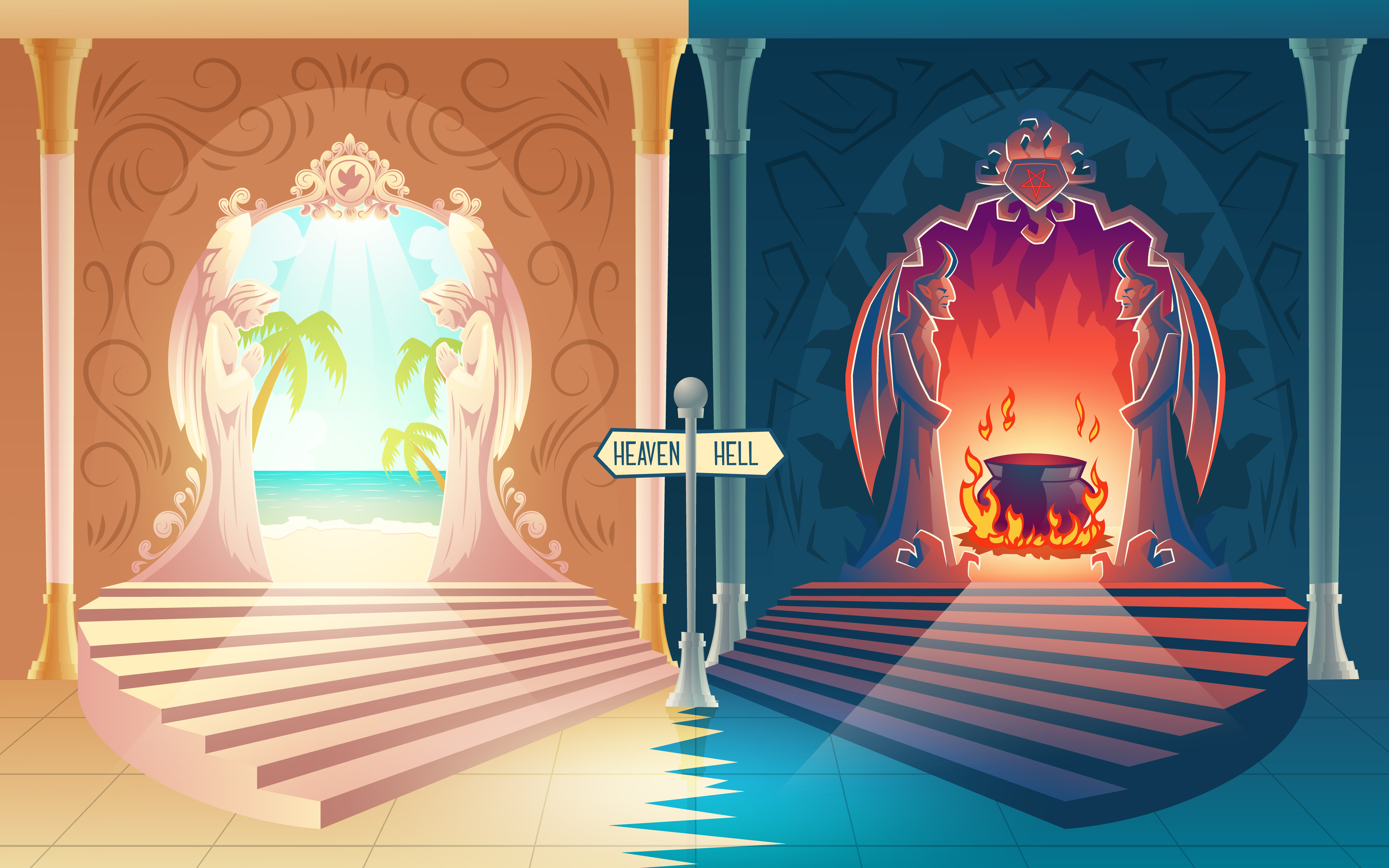
Throughout history, portrayals of the afterlife have echoed the values and anxieties of the societies that imagined them. Whether pictured as fortified realms, pastoral landscapes, or ordered cities, heaven and hell change with the times. Christian teachings about the afterlife did not arise in a vacuum but developed from earlier mythic and cultural sources.
It Depends on How You Look At It

Visions of the afterlife differ dramatically from one culture to another, prompting the inevitable question: which is true? Such doctrines often echo the moral priorities and fears of their time. Christian notions of judgment, reward, and punishment were no exception, developing alongside broader social and theological shifts.
How History Invented the Christian Afterlife

Heaven was not an original feature of early Hebrew belief. It arose out of crisis. Exile and suffering pressed Jewish thinkers to account for injustice beyond death, and the martyr’s fate required resolution. Resurrection and reward answered that need. Christianity inherited and expanded these developments, eventually constructing its own elaborate framework of judgment and punishment.
The Myth of the Spirit World

Early Christians reframed Jewish scripture to support a new theological vision. Their depictions of heaven and hell echoed Greco-Roman motifs but intensified them, presenting eternal reward and punishment as the final verdict on human life.
From Divine Presence to Celestial Bureaucracy

Early biblical texts blur the boundary between God and his messengers, an ambiguity later theologians worked to resolve. Over time, angels hardened into a ranked celestial bureaucracy. Christian portrayals of heaven followed the same trajectory, absorbing cultural influences as they grew more elaborate.
Hell Came From Nothing

Hell was not an original Hebrew doctrine. The idea of a fiery realm of punishment took shape gradually, fueled by apocalyptic dualism and intensifying visions of cosmic conflict. Movements like the Essenes framed history as a battle between light and darkness, preparing the soil for later Christian claims about eternal judgment. Much of what modern Western culture imagines as Hell owes more to literary figures like Dante (and later Milton) than to early biblical texts.
When the Story Doesn’t Match the Tradition

Early Christian texts show marked restraint about hell. The Gospels, especially Mark, emphasize moral urgency and transformation rather than detailed depictions of eternal punishment, indicating that later doctrine pushed well beyond the earliest sources. Beliefs about the afterlife developed over time, not as a complete system directly delivered in Jesus’ teachings. Subsequent theology amplified and systematized hell into a defined doctrine of eternal damnation.
From Early Restraint to Doctrinal Certainty

The modern idea of Hell as eternal torment is not found in the earliest Christian writings. Key biblical terms—Sheol, Hades, and Gehenna—were later translated and interpreted in ways that constructed the myth of hell. Paul’s earliest letters, written before the Gospels, focus on resurrection and transformation, not postmortem punishment. The doctrine of hell arose from theological disputes, translation decisions, and institutional interests, not from a clear or consistent scriptural mandate.
From Persecution to Punishment

The fully developed concept of eternal torment did not exist at the outset of Christianity; it emerged gradually over several centuries. Early Christian sources focus on Christ’s imminent return and human mortality, not on a fixed doctrine of eternal damnation. Apocryphal writings and later theological reflection introduced vivid depictions of hell, and by the sixth century the doctrine of eternal torment stood firmly embedded in official church teaching as a tool for reinforcing faithfulness and defining orthodoxy.
The Emerging Satan, Ruler of Hell

Satan evolved from a functional role within early Hebrew thought into a personalized cosmic adversary over time. Sectarian conflict during the Second Temple period significantly reshaped the concept of evil, externalizing it into a rival force opposed to God. Early Christianity inherited and intensified these developments, transforming Satan into the ruler of Hell and the embodiment of ultimate evil.
The Devil Christianity Needed

To explain the persistence of evil, early Christian thinkers increasingly depicted Satan as a distinct personal being. Apocalyptic and Gnostic ideas sharpened the image of this powerful cosmic adversary, which church leaders then used to define orthodoxy and attack rivals. The doctrine of Satan preserved God’s goodness while accounting for suffering and conflict.
The Living End?

What many treat as timeless doctrine began as evolving myth shaped by history and culture. Demanding literal belief turns symbolic moral narratives into tests of loyalty and boundary‑making. Heaven and hell still shape the American imagination — but how we interpret them determines whether they deepen moral reflection or restrict it.