
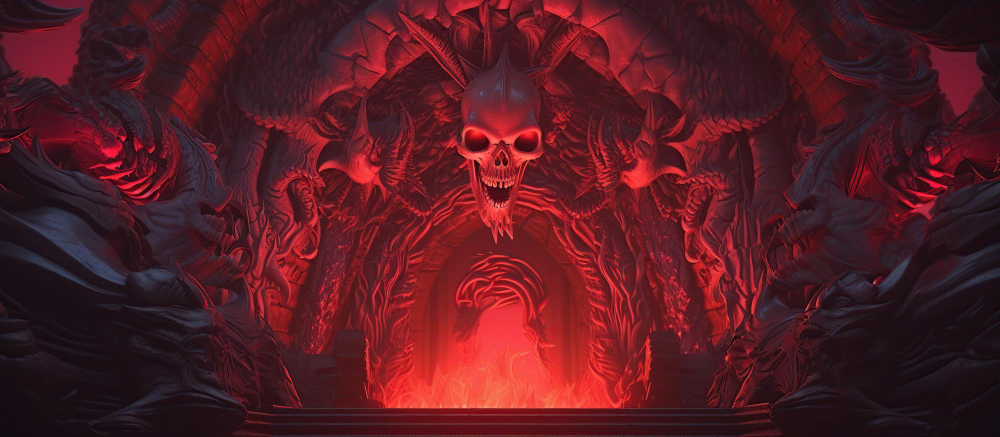
(Image by Freepik)
Hell Came From Nothing
(10 minute read)
Key Takeaways:
- The Concept of Hell Evolved Over Time. The idea of hell did not originate as a fully formed doctrine in early Hebrew belief. The concept of a fiery, punitive afterlife developed gradually through cultural, theological, and historical influences.
- Apocalyptic Dualism Shaped Early Christian Thought. Groups like the Essenes introduced stronger themes of cosmic conflict—light versus darkness, good versus evil—which helped lay the groundwork for later Christian ideas about judgment and eternal consequences.
- Later Writers Dramatically Influenced Modern Hell Imagery. Much of what modern Western culture imagines as hell owes more to literary figures like Dante (and later Milton) than to early biblical texts with cultural storytelling significantly shaping how hell is pictured today.
In The Emerging Christian Myths 6 we looked at how biblical narratives blur the distinction between God and angels. Over time these ambiguous figures developed into a structured celestial hierarchy that reshaped Christian imagination. We saw that doctrines about angels and heaven emerged gradually through interpretation, cultural exchange, and theological debate rather than through a single, fixed revelation. By comparing Christian afterlife imagery with similar motifs across cultures, we can see that heaven was assembled over centuries from a shared imaginative vocabulary about judgment, moral order, and the unseen world.
Invisible World By Majority?
What if many of the ideas you were taught about heaven and hell were shaped more by cultural storytelling than by the earliest Hebrew or Christian texts? As you read, consider which beliefs you have simply inherited—and which you have personally examined. This exploration invites you to question, reflect, and engage with the historical roots behind some of Christianity’s most enduring myths.
When you think about the “invisible world,” what shapes your understanding most—scripture, tradition, cultural imagery, personal experience, or something else? How much of what you believe was carefully considered, and how much was simply absorbed over time?
In that same 2023 Gallup poll we mentioned in earlier articles, 59% of Americans surveyed said they believe in a literal place called Hell, and 58% said they believe in a literal Satan.
Just as we saw with angels in popular culture, demons, Satan, and Hell are equally present. From blockbuster horror films and prestige television to heavy metal music anthems and bestselling video games, these themes continue to shape the modern imagination. Whether depicted as frightening, symbolic, dramatic, or even humorous, they remain a steady part of our cultural landscape.
Not so long ago, certain actions—such as divorce, premarital sex, adultery, and homosexuality—were widely taught to carry the risk of eternal damnation. In the 1950s, for example, a Catholic who knowingly ate meat on a Friday during Lent might have been told they were committing a serious sin. Yet just as the list of serious offenses has shifted over time, so too has the way many Christians understand Hell itself.
For much of the ancient world, belief in an invisible world was not controversial—it was assumed. Spirits, divine beings, and forces beyond sight were woven into everyday explanations of illness, weather, morality, and fate. The modern distinction between “natural” and “supernatural” would have felt foreign to them.
The Hebrew Myth of Hell
For the earliest Hebrews, the idea of hell as later Christians imagined it was largely absent. The people who wandered in the desert for forty years envisioned only one destination after death: Sheol. It was described as a dry, shadowy realm where all souls—both good and bad—went alike.
It may be difficult for some to imagine, but compared to the vivid afterlife descriptions found in other cultures, Sheol was remarkably understated. There were no rewards or punishments—no pain and no pleasure. It was simply a quiet, shadowy existence in a dry, dusty underworld, without distinction or drama.
In its earliest stages, Hebrew culture showed little interest in the afterlife, even as neighboring societies developed elaborate beliefs about it. For the ancient Hebrews, there was no concept of hell, no realm of fire, no Satan, and no eternal darkness. Over time, however, a small separatist group began to introduce new theological ideas—ideas that would later influence some first-century Christians in significant ways.
A Cosmic War
The Essenes were a Jewish sect that emerged in the second century BCE during a time of political upheaval and religious tension in Judea. Many scholars believe they broke away because of the Jerusalem priesthood, which they viewed as corrupt and compromised by political alliances.
In response, they formed disciplined, separatist communities devoted to strict interpretation of the Torah, ritual purity, and covenant faithfulness. Their withdrawal was not merely social but theological—they believed they were preserving the true faith of Israel while the temple establishment had gone astray.
The Essenes organized themselves into tightly structured communities governed by strict rules of conduct and shared responsibility. Property was held in common, and new members underwent a lengthy initiation process before being fully admitted.
Daily life revolved around prayer, study of the Torah, manual labor, and communal meals eaten in ritual purity. They practiced frequent washings and maintained detailed regulations concerning cleanliness, believing that spiritual faithfulness required physical discipline. Their communities were marked by order, hierarchy, and a deep commitment to holiness in every aspect of life.
The Essenes developed a highly structured and apocalyptic worldview shaped by sharp dualism. They believed history was a cosmic struggle between the “Sons of Light” and the “Sons of Darkness,” with God ultimately bringing judgment upon the wicked. Their writings reflect expectation of a coming Messiah—possibly even two figures, a priestly and a royal leader—who would restore righteousness and vindicate the faithful.
Unlike earlier Hebrew traditions that were largely silent about the afterlife, the Essenes articulated clearer ideas about divine judgment, reward, and punishment, framing history as moving toward an inevitable and decisive end.
Mainstream Jewish leadership appears to have not viewed the Essenes in a favorable light. By withdrawing from temple life and rejecting the authority of the Jerusalem priesthood, the Essenes implicitly criticized those in power.
The Essenes’ strict purity rules and alternative interpretations of the Law set them apart from both the Pharisees and the Sadducees, making cooperation unlikely. While ancient sources do not preserve detailed rebuttals from temple authorities, the very fact that the Essenes chose isolation suggests deep religious and institutional tensions between them and the broader Jewish establishment.
The Essenes appear to have disappeared as a distinct group during the Roman destruction of Judea in the first century CE. When Jerusalem and the Second Temple were destroyed in 70 CE, the settlement at Qumran—often associated with the Essenes—was also overrun. If the Dead Sea Scrolls were preserved by them, they were likely hidden just before this devastation.
After this period, the Essenes are no longer mentioned in historical records, and unlike the Pharisees, they left no enduring institutional legacy, though some of their ideas may have influenced emerging Christian thought.
This matters for early Christianity because several themes prominent in Essene thought later appear in Christian preaching and writing. Ideas about an imminent end of the age, a coming Messiah, heightened concern for purity, communal sharing of goods, and a sharpened contrast between light and darkness all surface in the New Testament era.
While Christianity did not simply emerge from the Essenes, the movement developed within a Jewish world already shaped by apocalyptic expectation and more defined concepts of judgment and salvation. The Essenes help illustrate that these ideas were already circulating before the rise of the Christian sect.
The Christian Myth of Hell
With this background in mind, we can better understand how ideas about the afterlife continued to evolve as the Christian movement gradually distinguished itself from its Jewish origins. The transformation was neither sudden nor simple, but part of a broader process of reinterpretation and adaptation that would profoundly shape what later became known as the Christian concept of hell.
Before the Christian sect fully separated from its Jewish roots, a gradual shift began to unfold. Still grounded in Jewish faith and tradition, the group slowly expanded its perspective. They increasingly embraced and developed the belief in Jesus as the Messiah. Alongside this change, their understanding of the afterlife also evolved, influenced in part by ideas associated with the Essenes.
These developments created growing tension between the group and their Jewish brothers and sisters. The destruction of the Second Temple by the Romans in 70 CE further intensified an already fragile situation. Over time, as the differences became more pronounced, both communities came to see that their paths were no longer aligned. Eventually, they chose to part ways.
Historical records offer limited detail about how the schism ultimately unfolded. It may not have been a single defining event, but rather a gradual process over time. Scholars have proposed various explanations to bridge the gaps in the record, many of which are thoughtful and deserving of further exploration.
One explanation for the growing divide centers on the Romans’ destruction of the Jerusalem Temple in 70 CE. In the aftermath of that tragedy, both Jewish and Christian communities struggled to make sense of what had happened, and some came to see the other as bearing responsibility for the calamity.
Drawing on the story of Achan’s disobedience in Joshua 7, some interpreted the tragedy through a similar lens. In that passage, Achan secretly hoards forbidden plunder from Jericho after God had commanded that nothing be kept. When Israel is later defeated at Ai, the loss is interpreted as divine judgment for this act of disobedience. Once Achan’s wrongdoing is exposed, he is punished, and the story emphasizes how one person’s unfaithfulness could bring consequences upon the whole community.
Seen in this light, each community, in its own way, reasoned that God had allowed the destruction because of the other’s unfaithfulness. Some within the Christian sect suggested that the Temple fell because Jewish leaders rejected the Jesus-as-Messiah belief. Conversely, some within the Jewish community viewed Christian claims about Jesus as blasphemous and saw them as a possible cause of divine judgment.
Whatever the reason, followers of “The Way” began to dramatically veer from traditional Judaism.
Dante’s Path to Paradise
“The Path to Paradise Begins in Hell” –Dante, The Divine Comedy
Ask any American what the definition of hell is. Their answer often includes “a place set aside for the future punishment of the wicked after death.” Or words to that effect.
Where exactly did that belief about eternal damnation come from?
Many ancient myths included a world inhabited by ethereal beings—angels, demons, spirit guides, gods, goddesses, heavenly messengers, and others.
Many ancient myths included a world inhabited by ethereal beings …angels, demons, spirit guides, gods, goddesses, heavenly messengers, etc. Cultures gave common traits to these unseen beings. They were seen as impish entities. These beings seemed to relish interacting more with humans than with the natural world.
The Christian sect began to separate from its Jewish roots. As they began to recognize the differences from their Jewish brothers, they formed a new identity. Creating a more colorful definition of the afterlife did not happen overnight.
Dante’s line, “The path to paradise begins in hell”, reflects the structure and message of Dante Alighieri’s Divine Comedy, particularly the journey described in the Inferno.
In the poem, Dante the pilgrim must first descend through Hell, confronting the consequences of sin and the realities of moral disorder, before he can begin the ascent toward purification in “Purgatorio” and ultimately the vision of divine love in “Paradiso.”
The journey suggests that spiritual transformation requires honest recognition of one’s brokenness. Only by facing darkness and understanding its nature can the soul begin the movement toward healing, redemption, and paradise.
Over the centuries, Christian thinkers developed and expanded particular ideas about the afterlife, especially detailed portrayals of heaven and hell. While concepts of the afterlife existed in many ancient religions, Christianity placed distinctive emphasis on eternal reward and punishment, and later traditions—particularly in medieval Europe, most famously in Dante’s 14th-century Divine Comedy—produced some of the most vivid and graphic imagery of hell in Western literature and art.
If Dante shaped the architecture and punishments of hell in the Western imagination, the 17th century English essayist and poet, John Milton, shaped the psychology and drama of it through his poem Paradise Lost. In this epic retelling of humanity’s fall, Milton expanded the imaginative landscape of heaven and hell and helped define how later generations envisioned Satan, rebellion, and divine punishment.
For example, through Milton’s portrayal of Satan, the fallen angel defiantly declares, “Better to reign in Hell, than serve in Heav’n,” casting rebellion not merely as wickedness but as tragic pride and self‑assertion. This dramatic and psychologically complex vision of Satan profoundly influenced later depictions of cosmic rebellion, divine justice, and the moral drama of heaven and hell.
Although the doctrine of hell predates Dante and Milton, modern visions of hell owe much of their imagery to Dante.
Ironically, at various times throughout history, segments of the Christian church contributed to profound suffering. This occurred through events such as the inquisitions, the persecution of those labeled heretics, and, in some cases, forced conversions. In some instances, theological ideas about eternal reward and punishment formed part of the broader framework used to defend such actions.
Hell did not emerge in a single moment; it took shape gradually across centuries—shaped by theology, intensified by culture, and preserved in literature—reflecting the ongoing interplay between religious imagination and historical circumstance.
If the idea of hell has shifted so profoundly over time, the deeper question may not be what awaits us after death, but how our beliefs shape the world we are building in the present.
Read The Emerging Christian Myths 8
Sources
- R. Allen Killen, Hell, Wycliffe Bible Encyclopedia, Moody Press, 1982
- Elaine Pagels, The Origin of Satan, Vintage Books, 1995
- Charles Panati, Sacred Origins of Profound Things, Penguin/Arkana Books, 1996
- Russel Shorto, Gospel Truth, Riverhead Books, 1998
Leave a Reply