
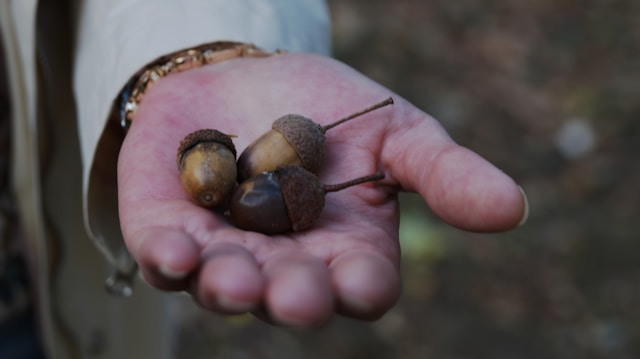
(Photo by Darya Tarnovskaya on Unsplash)
What Are We Doing Here?
(10 minute read)
Key Takeaways:
- Growing down precedes growing up. Before we can rise — in wisdom, influence, or presence — we must first root ourselves in the body, family, place, and circumstance we were given. The invisible work beneath the surface makes everything visible possible.
- We need models, not answers. No single philosophy holds the complete truth. What matters is choosing frameworks that bring our lives into focus — and being willing to set them aside when they no longer serve us.
- The soul has a blueprint. Hillman’s Acorn Theory argues that who we are is not simply the product of genetics and environment. There is a third element — an innate image of what we are meant to become — that asserts itself throughout a life.
- Growing down is a lifelong practice. Unlike transcendence, which favors the dramatic breakthrough, rooting is patient, largely hidden, and rarely glamorous. It is the quiet shift from wandering to belonging — and it is never fully finished.
“Coming into this particular body, and being born of these particular parents, and in such a place, and in general what we call external circumstances. All those happenings form a unity and are spun together is signified by the Fates.” –Plotinus, Second Ennead
We Need Models to Help Us Grow
Greek philosopher Plotinus lived, wrote, and taught through much of the third century and is ranked among the most influential philosophers of the ancient world. He spent most of his life interpreting Plato, updating his writings for a third-century elite — and those works have been cherished ever since.
Plotinus was the founder of Neoplatonism — the belief that all things emanate from a single, indescribable source he called The One. Not a being with physical form nor even a place, The One is beyond all categories: a pure, boundless origin from which existence itself flows. From this source the soul descends into the material world, and through knowledge and contemplation, it seeks to return.
This journey — the soul’s descent and eventual return — connects to the long-established Greek doctrine of transmigration, or reincarnation, explored by Pythagoras and Plato before him. Plotinus drew these threads together and carried them further in his Enneads.
In Plato’s Republic, souls preparing to be reborn must first drink from the River of Forgetfulness, washing away memories of past lives before entering a new body. The amount consumed determines how much is forgotten: wise souls drink less and retain something of their prior evolution; unwise souls drink deeply and start over entirely.
Pythagoras called this migration of the soul metempsychosis. To achieve spiritual purification and liberation, the soul — an immortal, divine spark — cycles through various mortal bodies, including animals and plants.
Aristotle disagreed. For him, the soul (psyche) was not a pre-existing entity that enters a body but the life force formed at birth — inseparable from the body it inhabits, and not persisting beyond it.
Hillman and other Jungian philosophers use these myths as a backdrop for their own philosophical leanings, sharing a worldview that asserts human life is inherently oriented toward individuation — the intention of individual wholeness and self-realization.
Hillman’s Acorn Theory — the notion of “the third way” — sees us as more than the sum of genetics and environment. It adds another dimension to our individuality: an innate way of seeing and defining ourselves that transcends the nature/nurture model. But this leaves a practical question: what do we actually do with it? How do we cultivate that inner seed?
As a species we excel at producing manuals. From printers to automobiles, we expect a guide to answer every question, with steps to guarantee ease, happiness, and longevity. We do much the same for human beings.
Want a specific education? There are classes, books, and credentials for that. Want to join a religion? Classes and rites of initiation exist for that, too. Civics groups, corporate boards, new employees — all are welcomed into the tribe through seminars and orientations.
There is nothing wrong with any of these paths — each has its place. Yet so often they become stepping stones to something else rather than meaningful pursuits in their own right. Learning and discovering are lifelong companions, and wisdom quietly grows within us for as long as we are able to receive it.
The great thinkers, from Aristotle onward, emphasized continually nurturing the mind, soul, and life force — regularly feeding them with culture, nature, intellectual challenge, and proper moral lessons. Deny either, and the life force withers.
It turns out we need models to help us grow. To nurture that life force we created myths — stories intended to convey eternal truths. They offer soul food, fanning the flames of our inner life, and create opportunities to learn how to uphold a society’s values and transcend worldly concerns. This is the soil in which the deeper question takes root.
So what do we do with this? How do we plant the acorn in fertile soil? Is there an optimal way of planting, feeding, and watering it — or do we simply press it into the dirt and hope for happenstance? And how do we know we aren’t wasting time chasing one philosophy over another?
All major religions offer their own language of transcendence. In the Christian tradition, the heavens carry special weight. The admonishment to “look up” in dire moments implies that better things are found above — while descent suggests something darker below.
The metaphors we’ve created for maturity and spirituality tend to favor the upward arc. Yet the oak doesn’t grow only above ground. After establishing deep roots, it thrives in both directions simultaneously.
Perhaps the point is never to find the one right philosophy. The acorn doesn’t choose the school of thought in which it grew — it simply grounds itself while growing towards light. What matters is that we have a map, imperfect as any map is, that keeps us oriented toward something worth becoming.
For centuries, one of the solutions to the question of how we live has been hidden in plain sight — not in the elevated metaphors of transcendence that Western tradition favors, but in the quiet, patient work of roots. It is the growing down part that Hillman and others insist we cannot afford to skip.
Growing Down
“Meaning is invisible, but the invisible is not the contradictory of the visible: the visible itself has an invisible inner framework, and the invisible is the secret counterpart of the visible.”
–M. Merleau-Ponty, Working Notes
Twentieth-century French philosopher Maurice Merleau-Ponty devoted his career to exploring the relationship between consciousness and the body. His concept called situated freedom meant that human free will is never completely abstract or limitless. Instead, every choice we make is rooted in and shaped by our physical, historical, and social reality. His work has shaped philosophical conversations in anthropology, architecture, art, environmental studies, feminism, film, language, and politics.
Across centuries, Western metaphors for self-determination have leaned toward transcendence — a rising above daily suffering and constraint. Transformation and awakening are pictured as a butterfly leaving its cocoon, a lotus flower emerging from the swamp, or an eagle soaring to a mountaintop.
While this upward, elevating perspective has its place, many Eastern religions and philosophies offer a complementary image: the need to “grow down,” to be grounded. Here the metaphor of the mighty oak growing from the lowly acorn is especially fitting.
The beauty of the oak is found in its trunk, branches, and leaves — the visible part that is admired, written about, and coveted. Yet an oak is only as strong as its roots. Roots give the tree its structure; the healthier the roots, the healthier the whole. They are where the tree draws most of its nourishment and quietly develops its strength.
When the acorn germinates a small shoot is visible above ground while a long taproot is sent below. Once established, the roots no longer plunge straight downward; they spread laterally, often reaching up to seven times the width of the tree’s canopy. A fully mature oak can contain hundreds of miles of roots, plunging as deep as a full yard into the earth.
Across cultures, religions, and literature, the oak has come to symbolize strength, steadfastness, assurance, and wisdom.
“Instead of a spirit of despair they will be called oaks of righteousness, a planting of the Lord for the display of his splendor.” –Isaiah 61:3, First Testament
“Oak trees come out of acorns, no matter how unlikely that seems. An acorn is just a tree’s way back into the ground. For another try. Another trip through. One life for another.”
–Shirley Ann Grau, 20th-century American writer
“Two live oaks stood at the end of the Radley lot; their roots reached into the side-road and made it bumpy. Something about one of the trees attracted my attention.”
–Harper Lee, To Kill A Mockingbird
“To plant a foot firmly on earth — that is the ultimate achievement, and a far later stage of growth than anything begun in your head.” –Hillman, The Soul’s Code.
The invisible/visible framework Merleau-Ponty describes finds its fullest expression in the work of growing down. It is the slow, deliberate labor of finding one’s roots and claiming a particular place in the world — a practice so essential, so foundational, that it often stretches across a lifetime. Unlike transcendence, which courts the dramatic moment, growing down is patient. It happens almost imperceptibly, as roots reach deeper into soil, gathering sustenance we cannot yet see.
Much of this work remains private, hidden from others as it rightfully should. It is the quiet shift from wandering to belonging — the moment when we know, beyond a shadow of doubt, that we have finally come home to where we are meant to stand.
As roots are formed, the canopy rises. The invisible allows the visible. What others see — growth, influence, presence — rests entirely on what remains unseen. Just as the oak needs deep roots to anchor against storms and draw vital nutrients to sustain its sprawling branches, our achievements require a grounding beneath them.
Hillman’s Platonic Model For Growth
Hillman describes the soul’s descent to earth through four interconnected modes: body, parents, place, and circumstance. Each shapes our journey and offers clues to our deeper purpose.
- Body: aging and returning to the earth, a literal and metaphorical descent
- Parents and family: the tree we’re born into, with all its beauty and twisted branches
- Place: where we plant our roots, with all its duties and customs
- Circumstance: what we’re given, and what we choose to give back
Each mode is an anchor to the world and a bridge to our potential. They reveal whether we’re sculpting our lives intentionally or drifting without direction.
As explored in the previous essay, The Acorn Theory 1, some find meaning in sudden and dramatic insight; others in a long unfolding of small choices — the same truth the acorn teaches us from the start. Both arcs are equally legitimate.
What is vital is our willingness to take root in the earthy, messy, sometimes difficult reality of life—because life’s richness lies exactly there.
How we answer “Who are we really?” depends entirely on how we see our own growing up and growing down. The philosophies we use to benefit that growth are not competing theories but different lenses on the same question. We choose the ones that bring our life into focus and set aside the ones that don’t.
There is nothing that says we have to stick to one school of thought for a lifetime. When the tools we’ve been using no longer work, we find new ones. It’s the difference between living rigidly and living ready — open to being reformed as life demands.
Editor’s note: This essay was originally a four part series titled The Acorn Theory: Finding Purpose in Life and was published from 2/5-9/2023. It has been condensed and edited for clarity and continuity.
Leave a Reply