
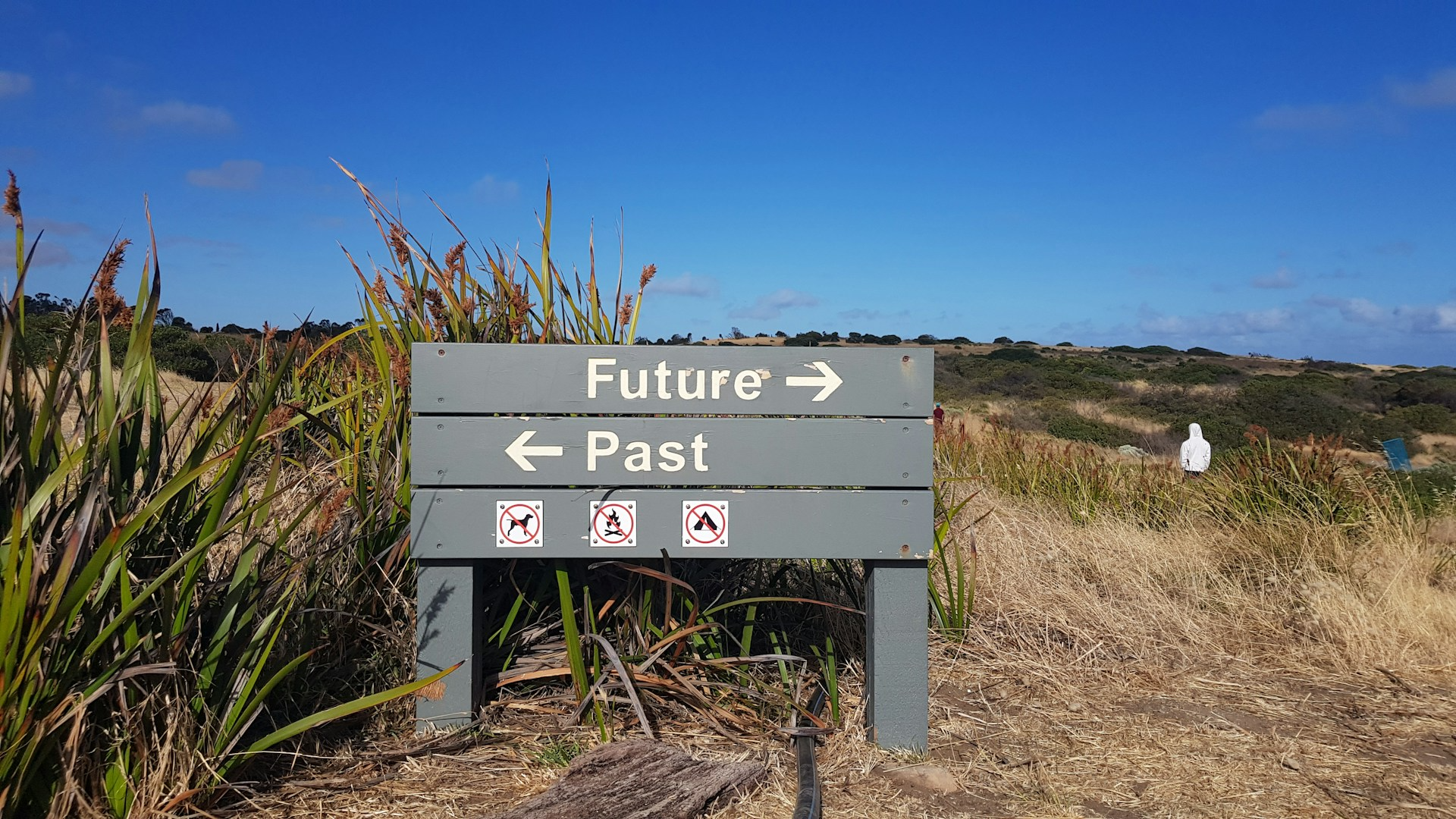
(Photo by Kouji Tsuru on Unsplash)
Your Future — Past
(10 minute read)
Key Takeaways:
- Finitude is clarifying, not paralyzing. Accepting that this life is all there is — without empirical evidence for anything beyond it — doesn’t lead to despair. It leads to urgency: relationships matter more, time is treated as scarce, and meaning stops being deferred.
- Montaigne showed us how to actually do this. Rather than prescribing how people should live, he documented how people did live — himself included. That shift from theory to lived experience remains the most honest model we have for navigating mortality.
- Dogma is the real problem, not belief. Private belief, however fanciful, is harmless. The collective cost comes when belief hardens into dogma and gets imposed on others — that’s when someone else’s metaphysics becomes your problem.
- Crisis is often the catalyst. Whether through near-death, trauma, or the deathbed regrets of others, most people arrive at these realizations too late — and too slowly. The post’s implicit challenge: why wait for the rupture?
The Retrospective View
In Part 2 of this series we introduced French philosopher Paul Ricoeur’s narrative identity: the self is shaped by memories, actions, and experiences woven into a continuous life story — one that, over time, becomes the story we tell ourselves and others.
In Part 3, we followed that idea to its conclusion through the life of 16th-century French nobleman Michel de Montaigne and his Essays. By spilling his most intimate thoughts, doubts, fears, elations, and curiosities onto the page, he showed us what it means to struggle to define oneself — and how a mind and its opinions shift with age. He has since become a companion for anyone drawn to the human condition.
Though Ricoeur and Montaigne lived centuries apart, their views on self-identity converge on a single ancient maxim — to philosophize is to learn how to die. Acceptance of finality isn’t a constraint — it’s a freedom.
Contrast those ideas with the various cultural fantasies of mortality as the unfinished story — the idea that death interrupts rather than concludes. For some, cheating death has become a pursuit in earnest, through mind uploading, anti-aging biotech, and AI-driven digital clones.
While science-fiction fantasies of cheating death* may be entertaining, the real cost is the distraction it creates — insulating us from reality.
The notion that consciousness continues in an afterlife — spiritually, psychologically, or scientifically — lacks empirical proof and requires reliance on magical thinking. Believing we’ll eventually exist in another realm — that today’s problems can be deferred — debases existence with unfortunate consequences.
- If God will destroy and remake this world, why spend resources fighting climate change — or anything else?
- This world and our flesh in it are corrupt. Real life begins only after this one is over.
- Dying for the cause now guarantees instant admission to eternal paradise.
- Suffering is a test of faith. To complain or protest risks any reward we have coming on the other side.
Those who find an afterlife unlikely, live accordingly — knowing the full arc of their story is shaped only at the end. Ricouer’s narrative identity and Montaigne’s reflective example remind us how inherently mortal we are, and how much that mortality demands an ending equal to the life lived.
While belief in an afterlife no longer resonates with a growing number of people, the fact remains that the majority of the world still believes in some form of one — without a shred of empirical evidence.
The issue is not in the belief itself. You can believe in invisible pink unicorns, as skeptics like Richard Dawkins have noted, but believing something is true doesn’t make it so. The larger collective problem arises when those convictions become dogmatic — demanding conformity. The line is crossed when belief seeks legal authority — when I believe in pink unicorns becomes and the law says your classroom must display one.
Pink unicorns aside, the unsettling implication of accepting finitude is that we are living toward an ending we cannot see. Yet, rather than deferring to a magical afterlife, living with finality allows for autonomy, authorship, and responsibility for our own story — all without giving up the very human need of a sense of wonderment.
That’s all well and good — but how does that actually work? What do we do with all this autonomy? What does a life look like without magical thinking? How have others made the transition?
What People Actually Do With This
From this vantage point let’s move from looking broadly at philosophy and show how this actually works. In other words, like Montaigne, let’s not look at how people should live and talk about how people have learned to live.
Yes — Montaigne is essentially our model and patron saint of that approach.
His Essays are the prototype: he wasn’t interested in building philosophical schools or even argue from established philosophical principles. Instead, he began with himself — his appetite for life, his fear of death, his unreliable memory — and let his experiences inform him about the bigger picture.
He confronted and wrote about the common perplexities of life — loss, failure, the mundane friction of relationships; how to avoid arguing with a wife, servant, or neighbor; how to reassure despondent friends. Rather than reaching for theoretical answers from the Ancients, something he already was more than aware of, he spent two decades writing about what he and others actually did — and how it felt internally.
Every man carries the whole form of the human condition within him, he wrote — a conclusion he arrived at through relentless observation. He worked from the edges of philosophy, treating his experiences as legitimate evidence rather than anecdote; a radical approach for his time. Philosophy was supposed to be universal and impersonal. Montaigne made it specific and embodied.
But, what could a 16th-century French nobleman possibly offer a 21st-century Instagram user? It’s a fair question. As Sarah Bakewell notes, when Gustave Flaubert advised a friend on how to approach Montaigne’s writings, he quipped: Don’t read him as a child would, for amusement, nor as an ambitious businessman, to gain something from it. No, instead, read him in order to live.
Had Montaigne lived today, he would have embraced modern technology — if only for the sheer pleasure of an immediate audience to his thoughts, and theirs to his. He was a keen people-watcher who delighted in hearing how others handled loss, family dynamics, and business.
Those who read Essays find that not all topics have aged well — some customs and ideas have ebbed and flowed across time. But much of what Montaigne wrestles with still holds up today. Run the gamut of social media platforms and you’ll find similar themes.
The more you try to control the future, the less you actually live in the present.
Be open to the diversity of perspectives the world offers.
Remember that you are a social animal with a deep-seated need to feel connected.
Find yourself through writing.
Accept who you are rather than who you think you should be.
Keep adapting to circumstances, despite the ongoing personal and social changes you face throughout your life.
One thing that stands out is the evidence that he was fully aware of impermanency, approaching every topic within that factual frame. He studied the Stoics and knew about their practice of appreciating life by being aware that it was fragile and might come to an end at any moment — Memento Mori.
The person who lives fully aware of how limited time is versus the person who doesn’t — what differs between them day to day?
Coming to grips with finitude brings a sense of urgency: this life counts, personal time is confined, and therefore precious. Daily habits are scrutinized. Meaningful relationships and work are prioritized, often without mercy.
The person who assumes tomorrow is guaranteed treats existence as if earth were an airport — their time here is little more than biding time, waiting for a connecting flight. They believe, without evidence, that life only really begins after this one is over — leading to distraction, procrastination, and dreaming of a vague later. Comfort is their baseline; meaning is an afterthought.
The difference between the two are clear and distinct. In radical fashion, the proximity of death informs us how to live.
Literature is replete with examples where a sudden, profound epiphany wakens people to face this fact. Scrooge in Dickens’ A Christmas Carol, Ivan in Tolstoy’s The Death of Ivan Ilyich, Raskolnikov in Dostoevsky’s Crime and Punishment, and American cultural movie classics like George Bailey in It’s A Wonderful Life, Melvin Udall in As Good As It Gets, and Phil Connors in Groundhog Day.
Many share similar reflections nearing the end of their lives: they wish they had stayed truer to themselves, spent less time focused on work, been braver about their feelings, mended relationships, and allowed themselves to be happier — much like the top five regrets often spoken of by the dying.
Spending more time at the office doesn’t make it on any list.
Regrets are as old as self-reflection itself. Yet, generation after generation, we often arrive at the same conclusions too late. It begs the question, why wait?
Traumatic events have a way of loosening entrenched beliefs we mistook for protection. New ways of seeing ourselves, our relationships, and the world often emerge from that rupture. Confronted directly, finitude wakens us to the inevitable.
Montaigne’s story is one prime example of what people actually do with this new reality. The Ancient philosophy he knew so well had been purely academic — until he was confronted with his own demise. What he chronicled was unexpected: he was no longer afraid. From that point, he chose to live meaningfully rather than by the abstract should and should-not philosophy had offered him.
In what he thought were his dying moments, he finally learned to live.
The Hard Problem: Living Forward, Judged Backward
At the very center of these essays is the tension of living a forward looking life while only understanding it by looking backwards. We can only evaluate the coherence of a life retrospectively — while living with an eye toward the future.
This isn’t a paradox to solve, like Schrödinger’s cat; it’s a condition to embrace and inhabit. How do we make choices now, oriented toward a life we can’t yet fully see?
With this new set of lenses we see that life is not something to resolve or prove — it’s a reorientation of how we live. Finitude means there are no guarantees of seeing loved ones beyond this life, so our priorities shift: we make choices that reflect that appreciation. There is no I’ll make it up to them someday. Instead, we live and love with the urgency of knowing we only have now.
Like life, the question we opened this series with — what would you call it? — remains open. I hope by now that sitting with that discomfort feels worth it — sit long enough with it and I promise it will. The mortality frame doesn’t answer our original question, but it does raise the stakes of caring about an answer.
For those who have faced mortality, the moments that follow become a clarifying pressure — what falls away and what remains. What stays is always personal: a moment, a relationship, a realization that only made sense as something worth cherishing because it is finite.
What would you call it? Because once you see it, you can’t unsee it. Tread with abandonment and courage — and for once, answer the question as if your life depended on it.
*See The Island (2005), In Time (2011), Transcendence (2014), and Self/less (2015) as examples
Additional Sources:
- Bakewell, Sarah, “How To Live Or A Life Of Montaigne,” 2010
- Bierlein, JF, “Living Myths: How Myth Gives Meaning To Human Experience,” 1999
- Zweig, Stefan, “Montaigne,” as translated by Will Stone, 2015
Leave a Reply