
(Photo by Darya Tarnovskaya on Unsplash)
What Are We Doing Here?
(10 minute read)
Key Takeaways:
- “Not this” is data, not defeat. Ruling out paths — careers, philosophies, identities — isn’t failure. It’s the process of elimination that steers us closer to what actually fits. Every dead end is a clue.
- Each person carries an innate calling. Purpose isn’t constructed from outside — it’s already present, waiting to emerge. Whether it shows up early or late in life, the seed is always there.
- Genetics and environment don’t have the final word. Science confirms both shape us — but neither fully accounts for human individuality. The gap between what our background predicts and what we become is precisely where the self lives.
- Who you are isn’t what you do. Roles — teacher, writer, mechanic — are outward expressions of inner character. The deeper question (who am I, really?) points inward, toward a “particularity” that no résumé or biography can fully capture.
“In the final analysis, we count for something only because of the essential we embody, and if we do not embody that, life is wasted.” –Carl Jung, Memories, Dreams, Reflections, 1961
“There is more in a human life than our theories of it allow.” –James Hillman, The Soul’s Code, 1996
Sometimes Not Knowing Helps Us to Know
Recently, I found myself in a conversation that most of us may have had from time to time. Speaking with an acquaintance whom I hadn’t seen for awhile, the idea that I was retired was, to say the least, a bit surprising.
“But you’re only …,” his brain calculating my age.
I cut him off. “Yeah, I know.”
He let the thought settle, then asked, “Well, are you doing anything to keep yourself busy? Because you know …?”
“Yes, I’m keeping busy.
“Oh, yeah? What are you doing?” he pressed.
“Traveling. Reading. I also paint in oils. A little writing.”
“Writing? What kind of writing? Fiction, or …?”
“No. Philosophy mostly. A little theology. My degrees are such.”
“Philosophy?” the tone indicating he liked the idea. “What kind?”
What kind? It’s always an odd question, as if I am about to be judged by the brand of car I drive. What school of philosophy, was what they were really asking. The problem is, I don’t really have a philosophy that completely works for me. I don’t really “fit in” with any that I’ve studied.
My intellectual pursuits and degrees mirror a personal search for questions that have long bothered me. What am I supposed to do? Where do I fit in? And most importantly, Who am I? These and a lot of other questions were troublesome for me. The quote in the Matrix franchise is apt for that nagging, “like a splinter in my brain.” There was something missing, something “more” that seemed to be out there, somewhere.
In a prior essay I described my experience toying with the idea of teaching philosophy. Seeing how philosophers had wrestled with life (some went mad) was one cautionary tale. The wide range of competing “schools of thought” was another. At times, I was also discouraged by the competitive nature among my peers, as we often tried to outdo one another with our newly acquired knowledge.
There is something else that also bothered me. No one school of philosophy or theology has ever settled the deepest questions. Philosophy is a worthy pursuit and I landed on some answers. But “doing” philosophy as a full-time gig — sitting in a mental circle with colleagues, each trying to out-Nietzsche the next? That was a hard pass.
Ruling something out as an option in life is not failure — it is evidence. Every “not this” narrows the field and pushes us closer to what actually fits. This is how medicine diagnoses illness, how science eliminates hypotheses, how a sculptor finds the figure inside the stone. Self-knowledge works the same way. Not knowing what you are for is not a defeat — it is a direction.
Which raises a deeper question. What if the elimination isn’t random? What if something in us already knew — and was simply steering us, quietly, by process of subtraction, waiting for us to catch up?
Hillman’s Acorn Theory
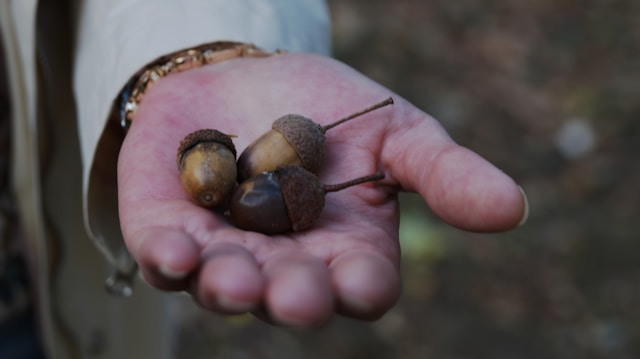
Jungian psychologist, James Hillman, wrote in his best seller, The Soul’s Code, what he referred to as the Acorn Theory. It supposes that each of us has a built in purpose or sense of fate (the daimon) and that this shapes our lives from the inside out.
Like every potential oak tree found in an acorn, this purpose waits to be revealed. Some are aware of that fate almost instantaneously, while most flounder until eventually stumbling upon it.
The theory is more mythical than empirical. There’s no way of measuring, locating, or testing the daimon and Hillman is aware of this, Nevertheless, he leans into it; there are enough people that report a sense of vocation or essential self that give the experience philosophical weight.
Hillman cites the lives of celebrities as examples of this theory because they are familiar to most. The stories excite, guide, and warn us allowing our imagination of our own fate to be found.
“We use them as examples, not to pull them down to our level, but to lift ours, making our world less impossible through familiarity with theirs. These personifications of heightened imagination burn right into the soul and are its teachers. Not only the hero and hero-worship, but tragic figures too.” –Hillman
In one such example, is the story of American film star, Judy Garland, as she comes to her own discovery of purpose. She tells the story how at the age of two she sat in a theatre transfixed by The Blue Sisters performing live music on stage. After the youngest sister delighted the audience with a solo, young Judy turned to her father and asked, “Can I do that, Daddy?”
Garland’s sister, Virginia, noted that “even in her two-year-old head, Judy already knew exactly what she wanted in life.”
Eventually she would become a worldwide stage and film-screen star. But, at that young age, Judy Garland was like the potential oak in the acorn.
American actor and Golden Globe winner, Austin Butler, had a similar experience, but at a much later age. A child actor on the Nickelodeon and Disney channels, Butler suffered from extreme shyness. and would beg his single-mother to order food for him when they attended restaurants. The thought of talking to a stranger terrified him.
One day, however, the oak began emerging from the acorn and at the age of 12, Butler found himself as an extra on a TV production.
“Up to that point I didn’t have a thing that I really could express myself with and somehow I ended up on a set …seeing the process, seeing the entire machine of how filming works and being around other actors. Suddenly, I felt like I found my tribe.” –Austin Butler, Hollywood Roundtable, 2023
Most of us aren’t as lucky to have perceived destinies appear with such flair. We might be hard pressed to come up with a competing story. Nonetheless, we do have a story.
Glimpses of our destinies are always there. Some may have been stifled. Others haven’t had the adequate environment to take root, let alone flourish. But they are there, for everyone, if we allow ourselves to be open.
It is easy to quickly dismiss stories of self-realization. It’s a shame, but many often categorize them as events that happen only to “chosen and extraordinary” god-like human beings.
You and I may never reach the heights of Mount Hollywood. Yet can we agree that each of us are born with a call to an individual destiny? Whether you are a brain surgeon or a car mechanic, this remains true. There is nothing mystical about it. Humans transformation is for everyone.
The Great Nature vs. Nurture Debate
“Genius can be bound in a nutshell and yet embrace the whole fullness of life.”
–Thomas Mann, as quoted in The Soul’s Code, Hillman
For well over a century, scientists have debated what shapes a human life. One school holds that genetics determines who we are; the other insists environment plays the greater role.
A generation of researchers moved closer to an answer through a decades-long study of twins — identical and fraternal, raised together or separated at birth. Because twins share the same DNA, researchers could isolate genetics as a variable and compare those raised apart with those who grew up in the same home.
If genetics dominated, environment could be ruled out — or vice versa. The nature vs. nurture debate might finally have a definitive answer.
The conclusion? Both are equally important.
“A strict dichotomy between genes and environment is no longer relevant; they work in concert,” American psychologist Nancy Segal told The New York Times in 2018.
While a philosophical and not empirical claim, Hillman believed there was a third and better way — one that lifts us out of the restrictions imposed by both nature and nurture.
If we accept that we are simply a product of genetics and environment, we risk a purely passive life — helplessly reduced to factors we never chose and cannot control. By the time most of us become aware of this, it can feel as though the die is already cast.
The more our lives are accounted for by chromosomes, by what our parents did or didn’t do, and by long-past formative years, the more our biography becomes one of passivity. Genetics and environment shape us, but they need not master us.
Nature and nurture together explain much — but neither alone is sufficient. When two people with near-identical genetics and environments turn out remarkably different — something is unaccounted for. There is a gap.
Hillman calls it “that particularity you feel to be you” — made up of:
- The individual we define
- The inner qualities we define
- The fullness of our humanness we define
- The self awareness of knowing every nook and cranny (the details) we define
That particularity is our essence or individuality: how we see and define ourselves, the voice of our daily inner dialogue.
Hillman’s answer to the gap is not the only one, but there are countless examples of people who refused to be reduced to a single identity — who transcended their socio-economic circumstances and became the first in their families to achieve something beyond what their background might have predicted.
Again, we turn to well known historical figures as examples.
- Frederick Douglass – leader of the 19th century American abolitionist movement, born into slavery, witness to great acts of violence, separated from his parents, taught himself to read
- Albert Einstein – father of modern physics, after graduating from university couldn’t get a job as a teacher or in any physics field, eventually found work as an assistant patent clerk, but was refused a promotion because he had a hard time learning how to use office machines
- Victor Frankl – Jewish-Austrian psychiatrist, a survivor of Auschwitz concentration camp, wrote Man’s Search For Meaning after he was freed detailing the universal human condition of our search for a meaning as the main motivational force transcending race, religion, or sex
These figures show that while genetics and environment are real forces, refusing to be defined by their limits is equally vital. Neither science nor environment fully explains us — so the question of who we are remains genuinely open, and worth pursuing.
Since the dawn of language, humans have tried to name this inner motivation. Depending on tradition or personal belief, we call it a soul, life force, character, calling, spirit, or daimon.
These concepts inspire and guide us — helping us, as Hillman notes, to be “emotionally and psychologically prosperous” and to develop individual and collective meaning.
To answer the question who are we really?, Hillman suggests we look inward rather than outward for the answer.
We often answer “Tell me about yourself” with a list of roles: teacher, artist, writer. But those are vocations — outward expressions of inner character. They are what we do, not who we are.
Who are we really? A mixture of genes and environment — good and bad, failures and potentials, much of it beyond our control. But that is only part of the answer.
We begin mining for deeper answers when we recognize the earthly limits of those genes and family ties — and dare to transcend them. That effort defines a third way.
A third way that refuses to be defined by limits. One that places us somewhere between the purely human and the aspirationally extraordinary.
Editor’s note: This essay was originally a four part series titled The Acorn Theory: Finding Purpose in Life and was published from 2/5-9/2023. It has been condensed and edited for clarity and continuity.
Leave a Reply