
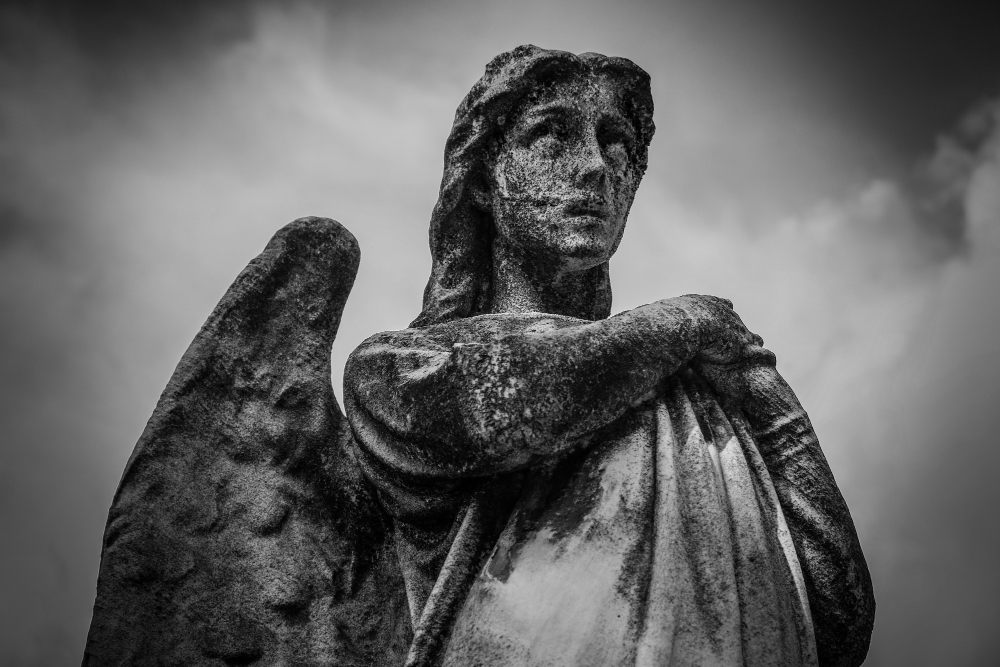
Image by wirestock on Freepik
From Divine Presence to Celestial Bureaucracy
(8 minute read)
Key Takeaways:
- Biblical narratives blur the line between God and angels, creating theological ambiguity later resolved through elaboration
- Angels evolved from vague messengers into a structured celestial hierarchy, shaped by expanding doctrine and imagination
- Christian concepts of heaven and the afterlife reflect cultural borrowing and development, rather than singular, fully formed revelation
In The Emerging Christian Myths 5 we examined how early Jewish and Christian ideas about angels, heaven, and hell developed over time. Many later doctrines were shaped by cultural exchange, translation choices, and theological reinterpretation rather than fixed original beliefs. Focusing especially on Genesis 18–19, we looked at how ambiguous figures described as “men,” “angels,” or even manifestations of YHWH reflected a fluid ancient worldview that resists later systematic angelologies. We also considered how tradition, language, and evolving religious imagination transformed complex biblical narratives into more rigid supernatural frameworks.
When God Can’t Be Found, Invent an Angel
Angels are among the most familiar figures in Christian imagination—winged messengers, radiant guardians, executors of divine will. Yet the biblical record tells a far more ambiguous story.
In its earliest layers, the line between God and his messengers is often indistinct, even interchangeable. Over time, these fleeting and sometimes confusing appearances solidified into an elaborate celestial hierarchy and a fully developed vision of heaven itself.
What later believers inherited as revealed truth may, in fact, reflect a gradual process of theological construction—one shaped as much by narrative tension and cultural exchange as by divine disclosure.
In its present form, the mysterious visitors in Genesis 19 gradually disclose who they are. They appear as messengers sent by God, carrying out a divine task. As the narrative unfolds, they seem to possess powers that go beyond ordinary human ability. When a crowd attempts to force its way into Lot’s house, the people are suddenly overcome with blindness. The text portrays them as overwhelmed by a burst of supernatural light.
The mystery surrounding these messengers deepens further when the narrative turns to the fate of Sodom and Gomorrah. As the account unfolds, the visitors identify themselves as the agents who will bring about the cities’ destruction. “We will destroy this place,” they tell Lot, “because …the Lord has sent us to destroy it.”
When the account reaches the moment of destruction, God is portrayed as the one who carries it out. The messengers are no longer described as acting in this role. As the text states, “The Lord rained down fire and brimstone from the skies upon Sodom and Gomorrah.”
So who is portrayed as carrying out the destruction—angels or God? This is not a minor detail or a trivial distinction. The wording is somewhat ambiguous. It is not clear whether God is acting directly or whether he is working through the messengers as his agents.
A biblical literalist might respond, “What difference does it make? The warning was given, and any power involved ultimately comes from God. The outcome was the same.”
What difference does it make? Setting aside, for a moment, that the story describes the destruction of an entire people for their lack of hospitality—not homosexuality (see Ezekiel 16:49 and Matthew 10:14–15)—the distinction still matters a great deal.
For many biblical literalists, the cause of Sodom and Gomorrah’s destruction is regarded as settled. The account is frequently interpreted as a condemnation of homosexual behavior and is often cited to support that reading. Other scholars, however, point to alternative interpretations found within the biblical text itself.
Some scholars maintain that God himself appears in Lot’s story, while others suggest that angels were acting on his behalf. Still others interpret the event as a natural disaster described in theological language. Even so, the account of Lot and the visitors reflects longstanding ancient beliefs about the divine—beliefs in which the gods are portrayed as unpredictable and more often associated with destruction than with the nurturing of human life.
This ambiguous portrayal of God—appearing human in one moment and divine in the next—recurs throughout the First Testament. The Hebrew Scriptures offer several examples in which God is described as directly encountering a human being. Is it God or an angel who wrestles with Jacob (Gen. 32:25)? Is it an angel of death, or the Almighty himself, who confronts Moses on the road to Egypt (Ex. 4:24–26)?
When God does appear in these accounts, the scene often feels more theatrical than intimate. The description can read less like standing before the “Lord of the Universe” and more like witnessing an elaborate display of dramatic effects.
- A bush that “burned with fire [but] was not consumed” –Ex. 3:2
- A pillar of cloud by day or a pillar of fire by night –Ex. 13:21, 53
- A disembodied voice heard only by a child in a darkened room –1 Sam. 3:8-9
Yet the prospect of God meeting a human being face to face introduces a profound tension.
On the one hand, the Hebrew Scriptures portray God as transcendent, holy, and overwhelming in power—so much so that no mortal can see God and live. On the other hand, these narratives repeatedly depict intimate encounters in which the divine seems to draw near, speak directly, and even take on a form recognizable to human beings.
The tension lies in holding these two images together: a God who is utterly beyond human comprehension, and yet somehow present in ways that appear immediate and embodied.
Celestial Bureaucracy
Some scholars argue that the development of angels may have served as a useful narrative device for the priesthood. In this view, God is portrayed as distant and set apart—someone not easily approached by ordinary people. God is also described as powerful and potentially dangerous. According to tradition, only one person, Moses, is said to have met God “face to face.”
It is understandable that some scholars approach these accounts with caution. They raise questions about the concept of celestial intermediaries. In these stories, such figures are described either as ordinary human beings or as striking, sword-bearing archangels.
Some scholars view these depictions with skepticism, suggesting they may represent later developments or reinterpretations. They point to differences between older and newer manuscripts as evidence. In earlier texts, the events are described as involving God directly, with references to angels appearing later and without clear explanation.
At the time, the printing press had not yet been invented, and scribes copied the scriptures by hand. In the process, some may have softened the descriptions of direct encounters between God and human beings. Over time, this may have contributed to the development of a more defined spirit world. While similar ideas existed in other cultures, such concepts were not as clearly articulated in early Judaism or Christianity.
Many Christian beliefs have roots in the Jewish tradition. Over time, Christianity, like several other traditions, further developed its understanding of the spiritual realm. Although angels often appear as secondary figures, they are present at pivotal moments in the early story of the church—at the birth of Jesus, at the resurrection, and at its founding. They also play a prominent role in descriptions of the end times, as outlined in Revelation.
These scriptural descriptions later inspired Renaissance artists, who painted and sculpted the figures that are familiar to us today.
The Christian worldview further developed themes rooted in Jewish tradition. Even a brief review of the New Testament reveals significantly more detail about the spiritual realm than is found in the Hebrew Scriptures:
- Beings created by God
- Not flesh and blood
- Holy and sacred
- Robed in white garments
- Radiated light
- Radiates God’s glory
- Referred to as men
- Evoked fear
- Are worshipped when confronting men
- Posses their own language
- Are intensely concerned with man’s salvation
- Main purpose is to worship God 24/7
They then embellished the tradition by drawing from elements found in ancient Greco-Roman cultures. When one compares aspects of early Christian belief with Greek mythology, the parallels can be striking. These similarities invite closer examination and help set the stage for a deeper look at how ideas about the spiritual realm evolved in conversation with the wider cultural world of the time.
Heaven Wasn’t Revealed — It Was Assembled
The evolution of angelic beings raises a broader question: did heaven descend fully formed, or was it assembled piece by piece?
Notably, the effects of this development have endured for centuries, as belief in angels remains widespread. A 2023 Gallup survey found that 69% of Americans believe in angels, 67% in a literal heaven, and about half in a personal guardian angel.
Popular portrayals of angels also help to sustain these myths. Films and television series such as Dogma, The Adjustment Bureau, Good Omens, Constantine, Lucifer, and Legion imagine heaven as a structured institution in which angels serve as administrators and stewards of human destiny, operating within defined cosmic rules and limitations.
The long lasting belief in angels reveal not merely lingering religious sentiment but a deep attachment to a structured unseen world. The historical record, however, suggests this cosmos did not arrive fully formed; it developed gradually, absorbing imagery, hierarchy, and narrative detail over centuries.
Parallels between Christian afterlife concepts and those of surrounding cultures suggest that external influences helped shape these beliefs. Even the adoption of terminology from Greek mythology underscores connections that are difficult to ignore.
Across cultures, structured visions of the afterlife recur:
- Mt. Olympus
- Hades
- River Styx
- Yomi
- Land of the Spirits
- Laws of Osiris
- Land of the Dead
- Underworld
- Purgatory
- samsara
- reincarnation
Viewed alongside these traditions, the Christian vision of the afterlife appears less isolated and more part of a broader human effort to imagine life beyond death. Themes of judgment, moral consequence, spiritual intermediaries, and structured realms of reward or punishment recur across cultures.
Although Christianity shaped these elements within its own theological framework over centuries, the parallels point to a dynamic exchange of ideas rather than isolated development. This context clarifies how the Christian afterlife assumed its distinctive form.
The recurrence of these motifs suggests that ideas of judgment, moral order, and cosmic geography formed a shared imaginative vocabulary long before Christianity gave them distinctive theological shape.
To identify as Christian is to participate in a tradition shaped by foundational narratives whose development is complex and contested. From a critical historical perspective, many core doctrines arose through layers of interpretation, redaction, and theological debate around ancient texts rather than a single, uncontested transmission.
The afterlife developed gradually, not fully formed. Over centuries, its doctrines were refined through ongoing interpretation and debate. The next article explores these developments in greater detail.
Read Emerging Christian Myths 7
Resources
- Carol Newsom, Angels, Anchor Bible Dictionary, Doubleday, 1992
- Jonathan Kirsch, The Harlot By The Side Of The Road, Ballantine, 1997
- Samuel Meier, Angels, The Oxford Companion To The Bible, Oxford University Press, 1993
Leave a Reply