
(10 minute read)
The Afterlife
Key Takeaways:
- Across history, descriptions of the afterlife have mirrored the social structures, ideals, and fears of the cultures that produced them
- From medieval fortresses to Renaissance landscapes to cosmopolitan cities, concepts of heaven and hell shift alongside changing worldviews
- Although interpretations vary widely, belief in an afterlife remains common, even though surveys show it has gradually declined in recent decades
- The development of Christian concepts of heaven and hell appears to borrow from earlier cultural and mythological traditions rather than emerging in isolation

Anthropologists suggest that humans have always wrestled with questions about life and the world around them. Out of these enduring questions, ideas of heaven took shape and were reinterpreted by each generation.
We pass along to the next generation what we have learned over a lifetime. Even so, each generation must find its own sense of meaning and purpose.
As we gather this knowledge, we naturally try to describe the unseen realities it suggests. This impulse has long shaped how people understand the afterlife. Ideas such as heaven, hell, angels, and demons emerge from that effort to make sense of what cannot be seen.
There are many written accounts of near-death experiences. Even so, heaven and hell cannot be fully described. They remain places beyond our direct experience.
It is worth noting that accounts of near-death experiences often reflect cultural influences. In the United States, people frequently describe a light at the end of a tunnel or encounters with deceased relatives. In India, such details are less commonly reported, and Buddhist accounts differ from both.
Our ideas about what heaven might be like can be described, even if imperfectly. As we will see, each culture has imagined its own vision of an ideal afterlife.
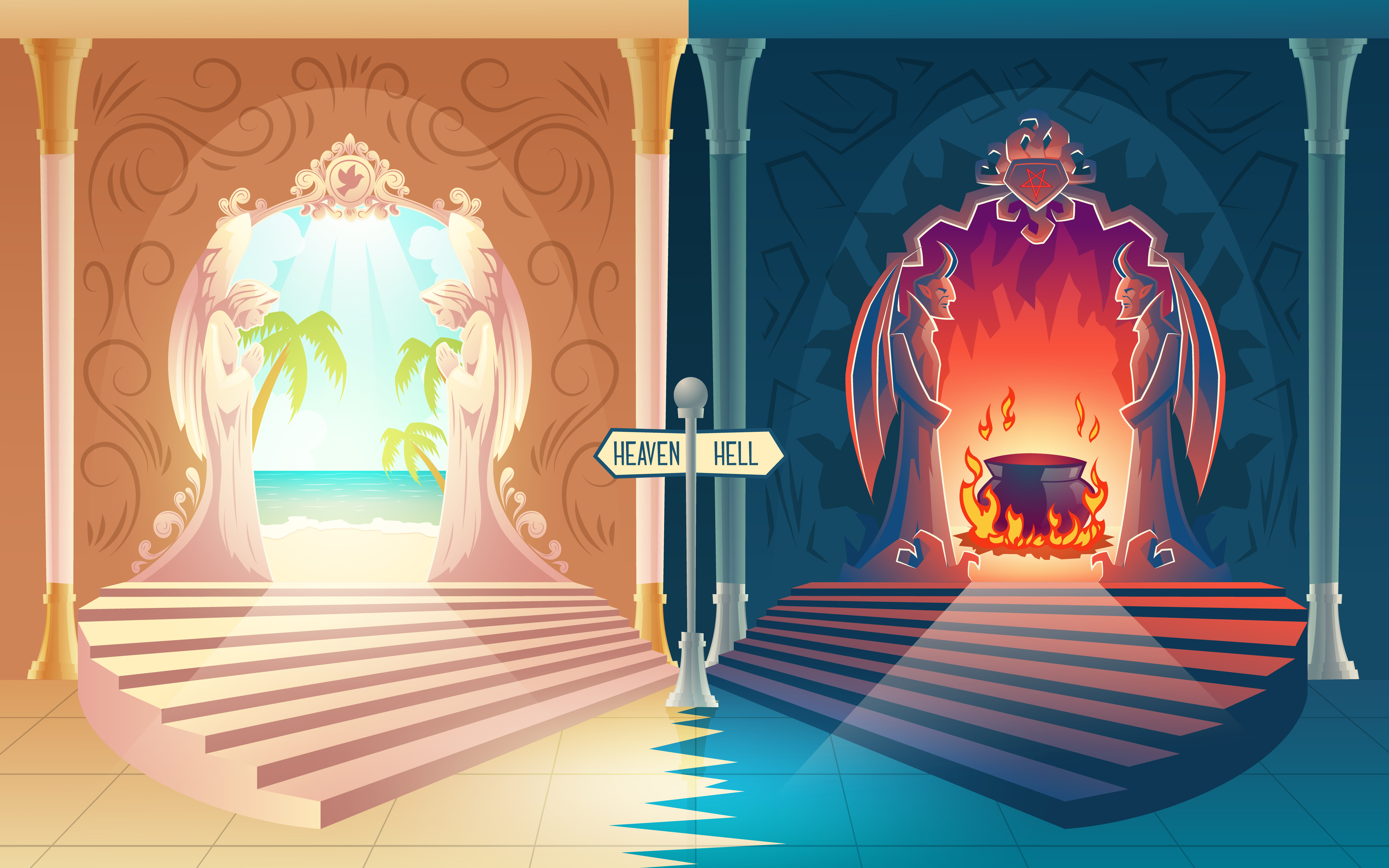
There are as many interpretations of the Christian heaven as there are authors who describe it. Yet a common thread runs through them all: heaven is understood as the dwelling place of God, a place of profound goodness and joy.
It is described as an unending, living joy. It is where the “real you” is said to dwell. There, a person is fully realized, reaching the fullness of their potential. In this sense, heaven is imagined as reality in its most complete form.
By contrast, the myth of hell is often described as the opposite of heaven—the absence of that divine reality. It is portrayed as separated from God and associated with the fallen angels, led by the archangel Satan, who is said to be condemned there. Hell is imagined as a place of suffering and loss. In this vision, the “real you” remains unfulfilled, never reaching your true potential.
How Afterlife Beliefs Shape Moral Choices
More than any other tenet of the Christian faith, the way the afterlife is understood influences the rest of its beliefs. Christianity has often been framed in terms of reward and consequence. What we believe about eternity shapes how we live in the present.
The idea of an afterlife is not new within the Christian tradition. As we will see, early Christians expanded and intensified their descriptions of hell’s suffering, emphasizing its severity in vivid ways.
Along the way, we will pause to acknowledge a 13th-century Italian poet and philosopher, Dante Alighieri, whose work has deeply influenced how many people imagine heaven and hell today.
Finally, we will consider how the Christian story of the afterlife seeks to address some of life’s deepest questions:
- Why are we here?
- What is our purpose?
- Why do bad things happen to good people?
- How can we control events happening in our life?
- How do miracles happen?
Like all cultures, Christian tradition drew on stories and ideas from those that came before it. Early Christians often supported these themes through particular readings of biblical texts. At times, however, it can seem as though those interpretations functioned more as a lens for understanding existing myths than as entirely new revelations.
Our Christian ancestors made certain leaps of faith. From a modern perspective, some of those assumptions may not have been well founded. In many ways, similar leaps continue to shape Christian belief today.
According to traditional Christian teaching about the afterlife, angels are said to dwell in heaven, while demons are associated with hell.
But what does that really mean? How did ideas about heaven and hell develop over time? How do people today understand them? Are they seen as literal places, states of mind, or something else entirely?
From Sheol to Eternal Damnation
Swearing was once regarded as blasphemous and deeply taboo. Even the word “hell,” now often used casually, carried serious weight. In more puritanical times, using it too freely was thought to risk divine punishment. Today, however, few clergy or theologians would warn of such literal consequences.
Over the years, I have spent time with both groups. In my experience, many clergy and academics can be surprisingly candid and colorful in their language, often in a way that feels disarming and human. I have generally felt at ease among them. Evangelicals, however, tend to approach such matters quite differently.
In addition to swearing, other actions once considered worthy of eternal punishment included divorce, fornication, adultery, and homosexuality. In the 1950s, for example, a Catholic who ate a hot dog on a Friday during Lent was believed to have committed a mortal sin. If left unconfessed, such an act was thought to jeopardize one’s salvation. All of this over eating meat during Lent.
Few people today would argue that such forms of punishment are appropriate. Of course, those examples are often associated with Catholic tradition, just one branch of Christianity. Yet change and reexamination are also taking place within many Protestant communities.
Homosexuality was once widely described as a “disorder.” In many Christian traditions, it was also regarded as a moral failing or even an abomination. Today, perspectives have shifted in numerous Protestant denominations, leading to significant debate and, in some cases, division over whether homosexuality should still be considered a sin.
The definition of sin and attitudes toward it are not fixed; they vary from group to group and tend to evolve over time. Some evangelical fundamentalist communities, however, understand these matters in ways that differ significantly from more changing perspectives.
The actions once believed to warrant eternal damnation have shifted over time. In much the same way, understandings of heaven and hell—the places associated with reward and punishment—have also evolved.
Because ideas about sin vary from one group to another, understandings of hell also differ, shaped by each culture’s beliefs and traditions.
- The early Ancient Greek myth of the afterlife described Hades as a distant island. All souls existed there in a perpetual state of zombiism. Later, they adopted the idea that souls were separated according to their conduct in life, good souls dwelt with good and bad souls dwelt with bad
- The Israelites history of wandering in the desert colored their myth of hell. Sheol was a dusty underworld in which good and evil souls commingled in a state of continual thirst
- The Norse myth of the netherworld, Nifheimr, was a place wracked by gale force winds, bitter cold, and a place of continual and total darkness
What, then, of the Christians? In time, Christian tradition would develop particularly vivid and influential depictions of damnation.
The concept of the Christian hell has its roots in the Israelite idea of Sheol. Over time, this understanding underwent a number of developments, gradually shaping hell into a far more severe realm. It has often been portrayed as a domain of profound suffering—an eternal state of both physical and emotional torment.
Descriptions of hell often include physical pain, eternal fire, and complete darkness—images that seem difficult to reconcile. After all, fire is typically associated with light, so how can it exist in total darkness? A common response is, “With God, all things are possible.” Yet the tension between these images remains.
Setting aside the contradictions in various descriptions, the central theme of the Christian myth of hell is eternal separation from God. When the focus shifts to debating “literal” details, the deeper symbolic meaning of the story can be overlooked.
Cultural Influences on Heaven and Hell
Myths about the afterlife often reflect a culture’s understanding of what is considered “good” and “bad.” In that sense, the vision of the afterlife does not come first; rather, it grows out of human experience and values, shaped in our own image.
There are, however, some shared themes. Heaven is often described as the dwelling place of the divine and the final home of the chosen souls. Beyond these broad similarities, the details tend to differ widely.
- For the Italian 13 century medieval visionary, Gherardesca, heaven was a sacred city surrounded by tall castles and fortresses; a feudal concept from someone living in a feudal land
- For the 16th century Italian bishop Francesco Colonna, heaven looked like the Italian countryside. He lived during the great Renaissance. In this heaven, “gorgeous maidens and beardless lovers frolicked in sunlit fields.” Sounds exactly what a Renaissance man’s ideal place to spend an eternity might look like.
- The 18th century Swedish theologian Emanuel Swedenborg thought that heaven was cosmopolitan. It had numbered streets and named squares. Angels lived in elaborate dwellings with grassy lawns that never needed cutting. Again, different culture but what one might expect a modern day thinker’s ideal place to spend eternity might look like
It appears that every culture has shaped its own vision of heaven and hell, and these portrayals often reveal more about a culture’s values and concerns than about the afterlife itself. In many cases, heaven and hell seem to take on the qualities people most need them to have. Heaven is typically described in terms of a culture’s highest hopes and ideals, while hell reflects its deepest fears and anxieties.
Belief in some form of an afterlife appears across many faiths, though its meaning and description vary widely. Even with that diversity, many people in the United States still believe in a literal heaven or hell.
- 59% of Americans say they believe in a literal place called hell
- 58% believe in a literal devil
- 67% believe in a literal heaven
- 69% say they believe in angels
- 50% believe they have a personal guardian angel
A majority of Americans continue to believe in an afterlife and its various elements. However, as the survey (linked above) indicates, these numbers have gradually declined over the decades.
As upcoming articles will make clear, myths of an afterlife have continued to evolve in many different forms. In that light, the Christian origin story of heaven and hell may be less unique than it is often assumed to be.
Read Emerging Christian Myths 3
*Sources
- J.F. Bierlein, Parallel Myths, Ballantine, 1994
- Joseph Campbell, The Power of Myth, Anchor Books, 1991
- Charles Panati, Sacred Origins of Profound Things, Penguin/Arkana Books, 1996
Leave a Reply