
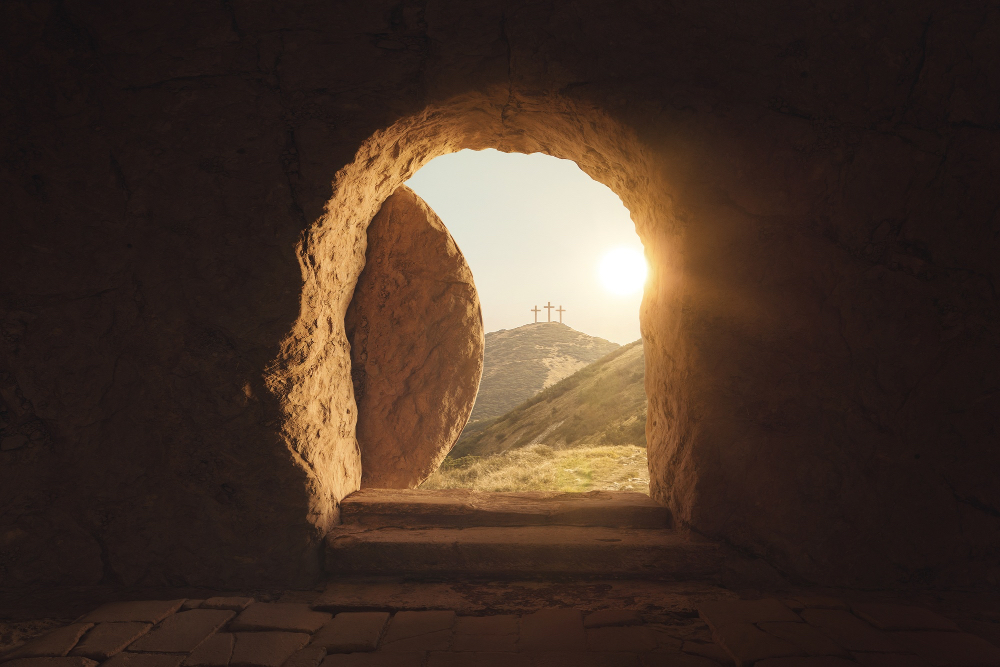
Image by Freepik
How History Invented the Christian Afterlife
(7 minute read)
Key Takeaways:
- Heaven was not an original feature of early Hebrew belief — it developed over time
- National crisis and exile pushed Jewish thinkers to rethink justice beyond the grave
- The deaths of martyrs demanded a theological answer — resurrection and reward provided one
- Christianity did not invent heaven from scratch; it inherited and intensified an evolving idea
In The Emerging Christian Myths 3 we examined how beliefs about heaven and the afterlife developed within Judaism and later Christianity, contrasting divine revelation with historical and cultural influence as possible sources. We traced the shift from early Hebrew views of a shared fate after death to later ideas of moral judgment and reward, shaped in part by Persian thought and the experience of exile. The Maccabean crisis further intensified reflection on divine justice, encouraging beliefs in resurrection and heavenly reward for the righteous.
“Many of those who will sleep in the dust of the earth shall awake, some to everlasting life.”
Daniel 12:2
“The righteous live forever, and their reward is with the Lord.”
Psalms 37:28 & 146:8-9; Isaiah 41:10-11)
From Survival to Sacred Promise
For early Hebrew believers, the belief that suffering in this life might one day be met with reward began to emerge gradually. The decade-long Maccabean War1 marked an important turning point, as the community wrestled more openly with how a life lost in battle might be honored or repaid.
The First Testament accounts offer only limited insight into how or why these beliefs developed. They appear in scripture mostly as settled ideas, noted after the fact rather than thoughtfully explained. In fact, we are told more about how ancient Israelite armies were organized and fought—details that are themselves sometimes fragmentary—than about how their understanding of the afterlife gradually emerged.
Early Hebrew faith was not a single, unified expression of belief. By the late Second Temple period, Jewish communities were already divided on a number of issues, including the question of the afterlife. The Sadducees appear to have rejected resurrection, while the Pharisees affirmed it, and sectarian groups such as the Essenes seem to have held even more developed expectations of post‑mortem vindication. The afterlife was not a settled doctrine but an active and ongoing discussion. The same faith and sacred texts often gave rise to different interpretations.
During the early centuries of the Common Era, Roman persecution of the Israelites intensified. In that climate of suffering and uncertainty, hope in a personal heaven, a bodily resurrection, and eternal life for the righteous became more deeply rooted.
Stories such as Elijah’s ascent into heaven may have served as early signs for the Israelites. They suggested that heaven was not only the dwelling place of God, but might also be understood as a future home for the faithful.
“As they were walking along and talking together, suddenly a chariot of fire and horses of fire appeared and separated the two of them, and Elijah went up to heaven in a whirlwind. Elisha saw this and cried out, ‘My father! My father! The chariots and horsemen of Israel!’ And Elisha saw him no more.”
2 Kings 2:11-12
The third century Jewish scholar Rav elaborated on the rewards believed to await the righteous in the world to come. In his teaching, the afterlife was not merely survival beyond death, but a transformed existence marked by closeness to God and freedom from the burdens of earthly life. Such reflections helped shape a more defined and hopeful vision of what faithful endurance might ultimately lead to.
“In heaven there would be no eating, drinking, or begetting of children. There would be no business dealings, jealousy, hatred, or competition. The righteous will sit with crowns on their heads and enjoy the glory of God’s radiance.”
It is a comforting promise. The burdens and anxieties of earthly life fall away, leaving only the peace of resting in the presence of God.
By the time Christianity began to emerge, this understanding of heaven was already widely held. It would go on to serve as a foundation upon which early Christian interpretations of heaven were built.
Early Christian Myth of Heaven
Christianity began as a movement within Judaism—seen by some as a reforming sect and by others as a troubling departure. Early Christians continued to understand themselves as Jewish. They would carry forward many Jewish beliefs, at least until the growing divide between the two made that connection increasingly difficult to sustain.
As in other areas of emerging Christian belief, some reinterpretation of Jewish tradition took place. The idea of heaven remained meaningful, though many of the details familiar to later generations would not take shape until the thirteenth century CE. Over time, the concept was expanded in ways that helped the developing Christian community articulate its own distinct identity.
The separation from their Jewish counterparts gradually took shape in the aftermath of the destruction of the Second Temple in 70 CE. In the tense and uncertain years that followed, many within the broader Jewish community viewed the Christian movement as a disruptive influence. Over time, this growing divide led to the exclusion of Christians from the Jewish community altogether.
Over time, these emerging sects began to read the Jewish scriptures in new and increasingly literal ways. They reinterpreted certain passages and frequently applied specific lines to their understanding of the messiah, Jesus of Nazareth.
By the fifth century CE, Christians had long been reading Jewish writings through the lens of their developing faith. These texts were brought together with newer writings that had emerged from various Christian communities. Over time, both collections came to be regarded as sacred and authoritative—the “Old” Testament and the “New” Testament, though many scholars today prefer the terms First and Second Testament.
Just as the early Israelites spoke of rewards for those who suffered and died for their beliefs, the early Christian church also emphasized this idea. Those who were martyred were promised a meaningful and generous reward for their faithfulness.
As with many other cultures, early Christians engaged with existing ideas, and there are noticeable similarities between Greco-Roman views of the afterlife and early Christian thought. Works such as the Odyssey, the Aeneid, the writings of Plato, and later Dante’s Inferno reflect themes that resonate with concepts found in developed Christian teachings about the afterlife. These parallels suggest a shared cultural conversation rather than mere coincidence.
The differences become clearer when we compare the Hebrew Scriptures’ understanding of the afterlife with later Christian interpretations. A number of important distinctions emerge. Over time, the developing Christian tradition placed far greater emphasis on the afterlife than earlier Hebrew thought had done.
The earliest writers of the new faith offered more detailed descriptions and clearer promises of reward. They also spoke of consequences for those who did not remain faithful. As Christian understandings of the afterlife developed, heaven came to be seen as more than simply the dwelling place of God. It was imagined as a realm where the faithful would share in eternal life together.
In contrast, those outside the faith were eventually described as facing eternal separation from God, often portrayed through an increasingly torturous imagery of hell. This separation was understood as final and without remedy. Such portrayals reflect a theological framework built around profound rewards and serious consequences.
1 It is sometimes easy to gloss over a sentence like “the 10-year Maccabean War.” We often do this without considering the logistical expectations for a modern army. Let alone an ancient culture at war. (see “Patriot Battles–How the War of Independence Was Fought,” by Michael Stephenson, HarperCollins Publishers, 2007)
Read Emerging Christian Myths 5
Resources
- Charles Panati, Sacred Origins of Profound Things, Penguin/Arkana Books, 1996
- Russel Shorto, Gospel Truths, Riverhead Books, 1998
- Jeffrey Burton Russell, A History of Heaven, Princeton University Press, 1997
Leave a Reply