
(6 minute read)
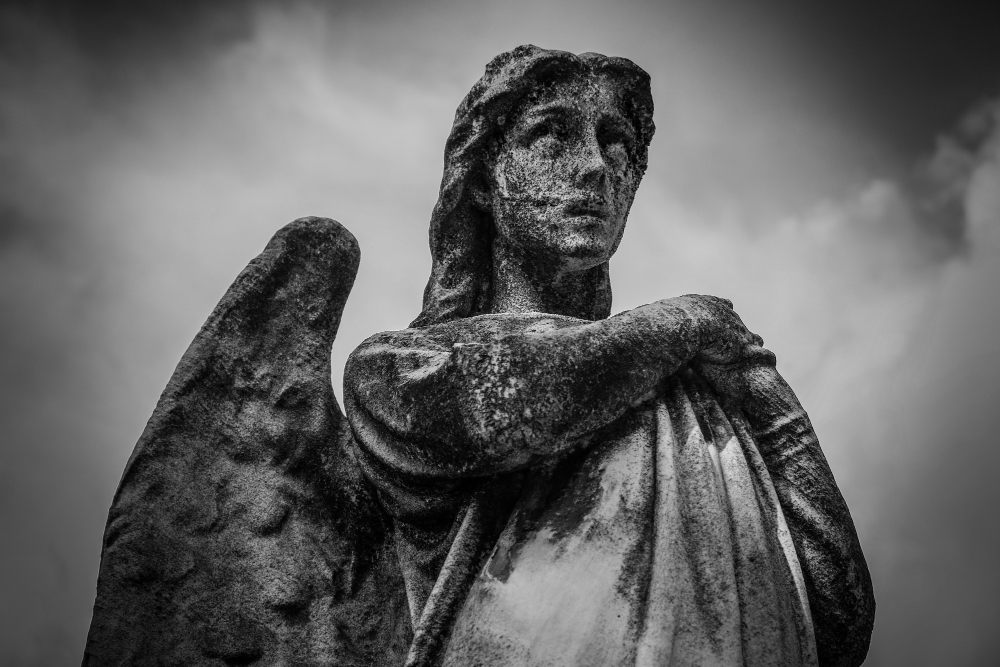
(From the previous post): The English word angel derives from the Greek word angelos. This word originally meant messenger. It was used to render the Hebrew word ma’akh in early Greek translations.
The celestial beings we are familiar with today were created in the 4th century CE. This happened when the scriptures were translated into the Latin form.
Prior to that, their existence was to be divine or human, left to the imagination, intentionally leaving them elusive.
To Add Confusion to Even More Confusion
In its current form, the mysterious strangers in Genesis 19 eventually reveal themselves. They are messengers on a mission from God …long before the Blues Brothers, Jake and Elroy. They are ready to carry out their orders.
As the story unfolds, it becomes clear that these messengers have godlike powers. When a mob tries to break into Lot’s house the mob is suddenly struck with blindness. The original text suggests that the townspeople were literally dazzled with a supernatural explosion of light. A blinding flash emanated from the messengers.
The mystery of these messengers only deepens. This happens when the writer describes the devastation that later befalls Sodom and Gomorrah. The messengers announce themselves as the soon-to-be destroyers of Sodom and Gomorrah.
“We will destroy this place,” they tell Lot, “because …the Lord has sent us to destroy it.”
When the moment of impending genocide arrives, we read that God himself is depicted as the destroyer. The messengers are not shown in this role.
“The Lord rained down fire and brimstone from the skies upon Sodom and Gomorrah.”
Is it angels or God who performs the genocide? We are not splitting hairs here, folks.
The phrasing is awkward. It is not known whether God is acting on his own. It is also unclear if he is empowering the messengers to act on his behalf.
A theocentric scholar or literalist will ask, “what difference does it make? They were warned about being punished and power comes from God anyway. The deed was done. Period.”
What difference does it make?
Putting aside the fact that we are talking about the genocide of an entire people for being inhospitable, …not homosexuality, (see Ezekial 16:49 and Matthew 10:14-15) …it makes a great difference.
Along with Arabs, Greeks believed in the hospitality of strangers. They even named a God, Zeus Xenios, as a protector of travelers and obligation to be hospitable to travelers. A violation of hospitality was to provoke his wrath.
The cause of the genocide of Sodom and Gomorrah is debated. Some argue it was God himself, while others believe angels acted on his behalf. Some scholars suggest it was a natural disaster. Nevertheless, the story of Lot and the strangers reinforces ancient beliefs. Gods “are very moody.” They are often depicted as destroyers more than creators of human life.
This ambiguous phenomenon of God found as “changeling,” human one moment, God the next, is found throughout the First Testament. The Hebrew Scriptures provides a handful of examples when God directly encounters a human being.
Is it God or an angel that wrestles with Jacob (Gen. 32:25)?
Is it an angel of death or the Almighty himself that confronts Moses in a murderous rage on the road to Egypt (Ex. 4:24-26)?
When God does mysteriously show up, it usually seems like a Cirque d Soleil trick. It is more like special effects wizardry than standing before the “Lord of the Universe.”
- A bush that “burned with fire [but] was not consumed” –Ex. 3:2
- A pillar of cloud by day or a pillar of fire by night –Ex. 13:21, 53
- A disembodied voice heard only by a child in a darkened room –1 Sam. 3:8-9
But God meeting man face to face is a rather precarious predicament.
The creation of angels turns out to be a convenient plot device for the priesthood. God should be aloof and reclusive and not so available to the common man. God is considered very dangerous. Only one man in all of history, Moses, is allowed to meet God “face to face.”
Is it a wonder that scholars find it suspicious? They question the whole notion of celestial go-betweens. They show up in the guise of an ordinary humans or a sword wielding archangels.
Scholars suspect these depictions as fraudulent. They are a late construction or misinterpretation. The change from older manuscripts to newer is the evidence. Earlier manuscripts describe the events as God in attendance and angels in the next with no explanations.
Of course the printing press hadn’t been invented yet. Scribes were tasked with transcribing scriptures by hand. Somehow they took it upon themselves to tone down the encounters between God and human. In doing so, they created a spirit world. This world existed in other cultures but never in the Jewish or early Christianity.
There are many tenets of faith with roots in the Jewish tradition. The Christians elevated the myth of the spirit world to new heights like many others. The angels are incidental characters and, yet, make appearances in watershed moments in the early years of the church. They are at the birth of Jesus, the resurrection, and the founding of the church. They bear a heavy presence in the end times as outlined in Revelations.
Their scriptural descriptions would later be used by Renaissance artists who painted and sculpted the creations familiar today.
The Christian mythical worldview elevated the myth of its Jewish roots. A quick systematic scanning of the second testament reveals a plethora of information about the spirit world:
- Beings created by God
- Not flesh and blood
- Holy and sacred
- Robed in white garments
- Radiated light
- Radiates God’s glory
- Referred to as men
- Evoked fear
- Are worshipped when confronting men
- Posses their own language
- Are intensely concerned with man’s salvation
- Main purpose is to worship God 24/7
They then embellished upon the myth by borrowing from ancient Greco-Roman cultures. when one compares the early Christian faith with Greek mythology the parallels are astounding.
- Mt. Olympus
- Hades
- River Styx
- Yomi
- Land of the Spirits
- Laws of Osiris
- Land of the Dead
- Underworld
- Purgatory
- samsara
- reincarnation
The Christian myth of the afterlife permeates our culture even today. According to recent surveys, those myths are very much alive and well. Sixty-nine percent of Americans who were surveyed believe in angels.
To be Christian means accepting certain questionable core myths. They are not disappearing anytime soon. But then again, the entirety of Christian beliefs, stems from an intentional misinterpretation of ancient scriptures that were willfully censored.
Can I be any clearer than that? If not, the next article will do so.
Read Emerging Christian Myths, Part 7
Resources
- Carol Newsom, Angels, Anchor Bible Dictionary, Doubleday, 1992
- Jonathan Kirsch, The Harlot By The Side Of The Road, Ballantine, 1997
- Samuel Meier, Angels, The Oxford Companion To The Bible, Oxford University Press, 1993
