
(6 minute read)
The Emerging Myths of an Afterlife
The use of myth often utilizes symbolic and metaphorical language. It is among the first ways humans try to explain the world they live in.
They are not the quaint beliefs of ancient and uneducated people. Instead, they describe practical models for understanding how to live. They also form the basis for cultural identity.
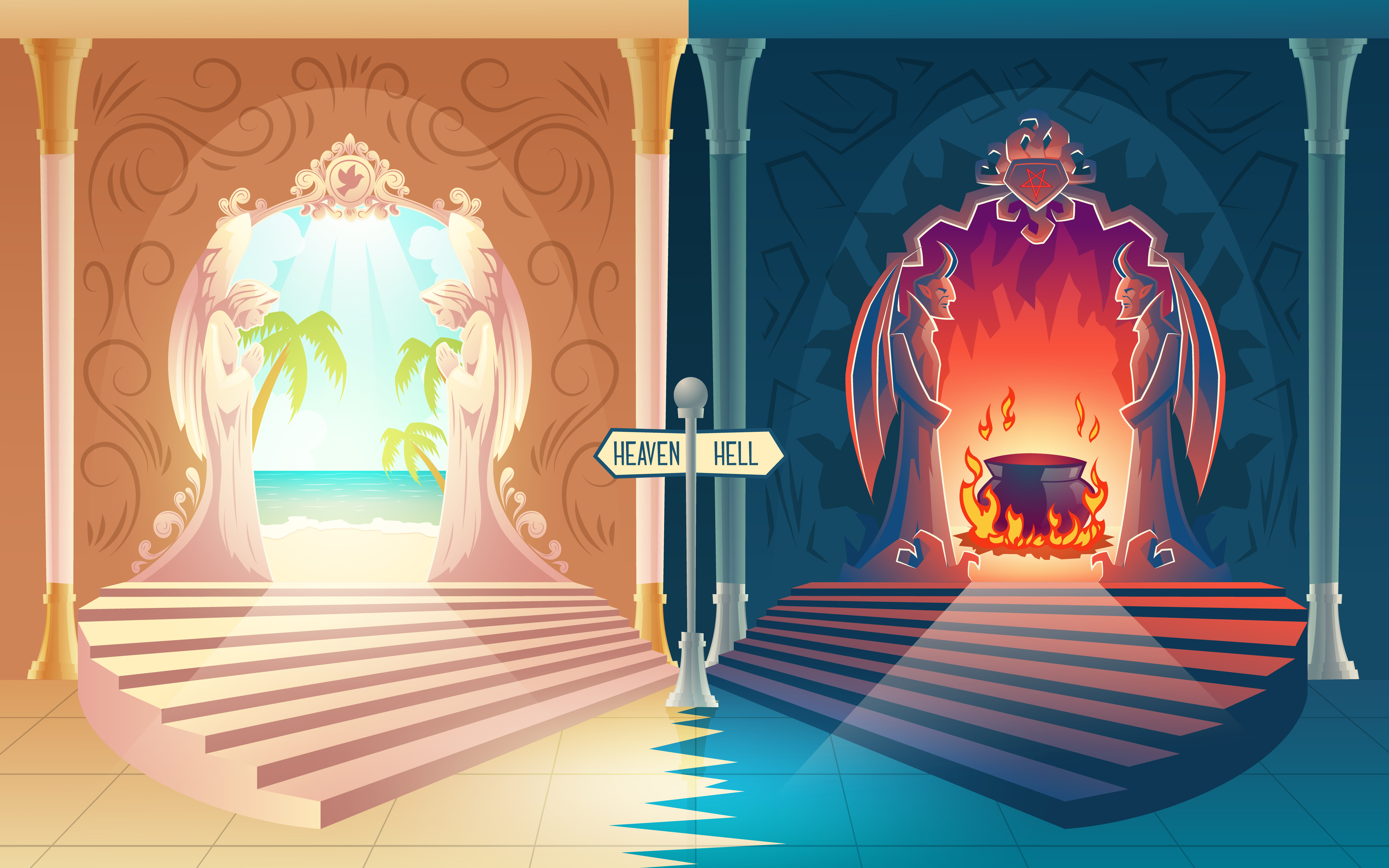
According to the Christian myth of the afterlife angels dwell in heaven and demons can be found in hell.
But what exactly does that mean? How did the myth of heaven and hell unfold? What does modern man think of heaven and hell? Are they literal places, states of mind, or something completely different?
Hell
Swearing was once considered blasphemous and taboo. Hell is just one of many four-letter swearwords. If used too often in puritanical times, it sent you straight to the literal place. Today, there aren’t many clergy or theologians that would threaten that punishment.
Personally I have spent years with both groups of people. I have found that clergy and academics are endearingly some of the most foul-mouthed individuals you’ll ever meet! I feel right at home with most of them. Evangelicals, however, are a different animal indeed.
Besides swearing other transgressions once worthy of eternal damnation were divorce, fornication, adultery and homosexuality. In the 1950s, a Catholic eating a hot dog on a Friday afternoon during Lent committed a mortal sin. This unrepentant act earned a place in hell for eternity. For eating meat …during Lent?
Does anyone believe that type of corporal punishment is warranted today?
Oh, but that is the Catholics, just one of the many subsets of Christianity.
Well, today, there are reformations taking place in protestant places as well.
Homosexuality was once thought of as a “disorder” at best. At worst, it was considered a choice of evil and an abomination by every major Christian denomination. Today, it has caused schisms in several Protestant faiths that no longer consider homosexuality a sin.
The definition and attitude of sin is not static differing from group to group and changes or evolves over time. Except for evangelical fundamentalists living in a whole different universe.
The offenses that used to merit eternal damnation have changed over time. Similarly, the places where the rewards and punishments are to be doled out, heaven and hell, have changed.
Given that sin differs from group to group the myths of hell also differ depending on one’s culture and beliefs.
- The early Ancient Greek myth of the afterlife described Hades as a distant island. All souls existed there in a perpetual state of zombiism. Later, they adopted the idea that souls were separated according to their conduct in life, good souls dwelt with good and bad souls dwelt with bad
- The Israelites history of wandering in the desert colored their myth of hell. Sheol was a dusty underworld in which good and evil souls commingled in a state of continual thirst
- The Norse myth of the netherworld, Nifheimr, was a place wracked by gale force winds, bitter cold, and a place of continual and total darkness
What about the Christians?
Ah, yes. The Christians.
Well, the Christians would raise the art of damnation to new heights.
The concept of the Christian hell originates from the Israelites myth of Sheol. It would undergo a number of modifications. These changes made it the severest of places. Hell is often described as a kingdom of cruelty. It is an eternal furnace of physical and emotional torment.
External pain, eternal fire and utter darkness? A dichotomy of definitions.
How can fire, which produces light by its very definition, exist in a place of total darkness?
The usual answer with fundamentals, “With God all things are possible.”
Really?
Contradiction in descriptions aside, the purpose of the myth of the Christian hell is the eternal separation from God. Where fundamentalists want to bicker over “literal” details the beauty of the myth is lost.
Different Strokes for Different Folks
The afterlife myths are influenced by the “good” and “bad” of a culture. This influence means the afterlife wasn’t created first. Instead, we have created the afterlife after our own likeness.
There are commonalities, however. Heaven is for the God(s) and the final home of the immortal souls of the chosen. The similarities generally end there.
- For the Italian 13 century medieval visionary, Gherardesca, heaven was a sacred city surrounded by tall castles and fortresses; a feudal concept from someone living in a feudal land
- For the 16th century Italian bishop Francesco Colonna, heaven looked like the Italian countryside. He lived during the great Renaissance. In this heaven, “gorgeous maidens and beardless lovers frolicked in sunlit fields.” Sounds exactly what a Renaissance man’s ideal place to spend an eternity might look like.
- The 18th century Swedish theologian Emanuel Swedenborg thought that heaven was cosmopolitan. It had numbered streets and named squares. Angels lived in elaborate dwellings with grassy lawns that never needed cutting. Again, different culture but what one might expect a modern day thinker’s ideal place to spend eternity might look like
The point is that every culture has offered a view of what they believe heaven and hell looked like. Their definition tells us more about their culture than any actual fact of what heaven or hell is really like.
It seems that heaven and hell is always whatever people need it to be. Heaven is always portrayed with the most positive qualities imaginable to that culture and hell the most negative qualities imagined.
Although the myths of an afterlife are almost universally accepted by people of all faiths, their definitions obviously vary. All these different myths, though, have not stopped people from believing in a literal heaven or hell.
- 59% of Americans say they believe in a literal place called hell
- 58% believe in a literal devil
- 67% believe in a literal heaven
- 69% say they believe in angels
- 50% believe they have a personal guardian angel
The majority of Americans still believe in an afterlife and all its elements. However, it is apparent from the survey (link above) that the numbers have continued to decline over the decades.
It will also be obvious from upcoming articles. Myths of an afterlife have continued to evolve in their various forms. Yet, the Christian origin story of the emergence of heaven and hell is not so original.
Read Emerging Christian Myths, Pt. 3
*Sources
- J.F. Bierlein, Parallel Myths, Ballantine, 1994
- Joseph Campbell, The Power of Myth, Anchor Books, 1991
- Charles Panati, Sacred Origins of Profound Things, Penguin/Arkana Books, 1996
