

Living a Life “Less Ordinary”
(10 minute read)
Key Takeaways:
- Most of what disturbs us is outside our control. Perceived chaos may be all around, but we retain control over our responses. Focusing on only what we can control protects clarity and sanity.
- Living “ordinary” today means being overstimulated and reactive. Hyper-connectivity, constant outrage cycles, and tribal politics distort perspective. Stepping back is self-preservation.
- Strength comes from knowing your lane and honoring your abilities. Fulfillment grows when we focus on what we do well rather than chasing every cultural battle.
- Holding fast to your values requires courage. In times of pressure—social, political, or institutional—the temptation to conform is powerful. Integrity means refusing to bend your convictions for comfort or approval.
Have you noticed lately that the news feels, to put it gently, discouraging? Maybe even more than that. Do you sometimes find that just reading the headlines is enough to leave you feeling unsettled or worn down?
Some examples:
- European allies forge ahead with their own plans to bring about peace in Ukraine
- Tariffs are announced on goods from Canada, Mexico, and China
- Stock market tumbles
- Polls show majority of Americans not in agreement with Maga
- Forest fires breakout not only in California but in Georgia, South Carolina, Texas, and Oklahoma as well
How did things get so, weird?
In the meantime, politicians comment and traditional media report these headlines as though it were business as usual. Perhaps they, too, feel overwhelmed, describing events like observers of a “near drowning.” They recount the water and the waves in detail, yet seem unable to do more than watch as the “drowning man” struggles for air.
As if to add insult to injury, Vann R. Newkirk II of the Atlantic wrote his piece “When the KKK Came to D.C.” The infamous picture below accompanies the article.
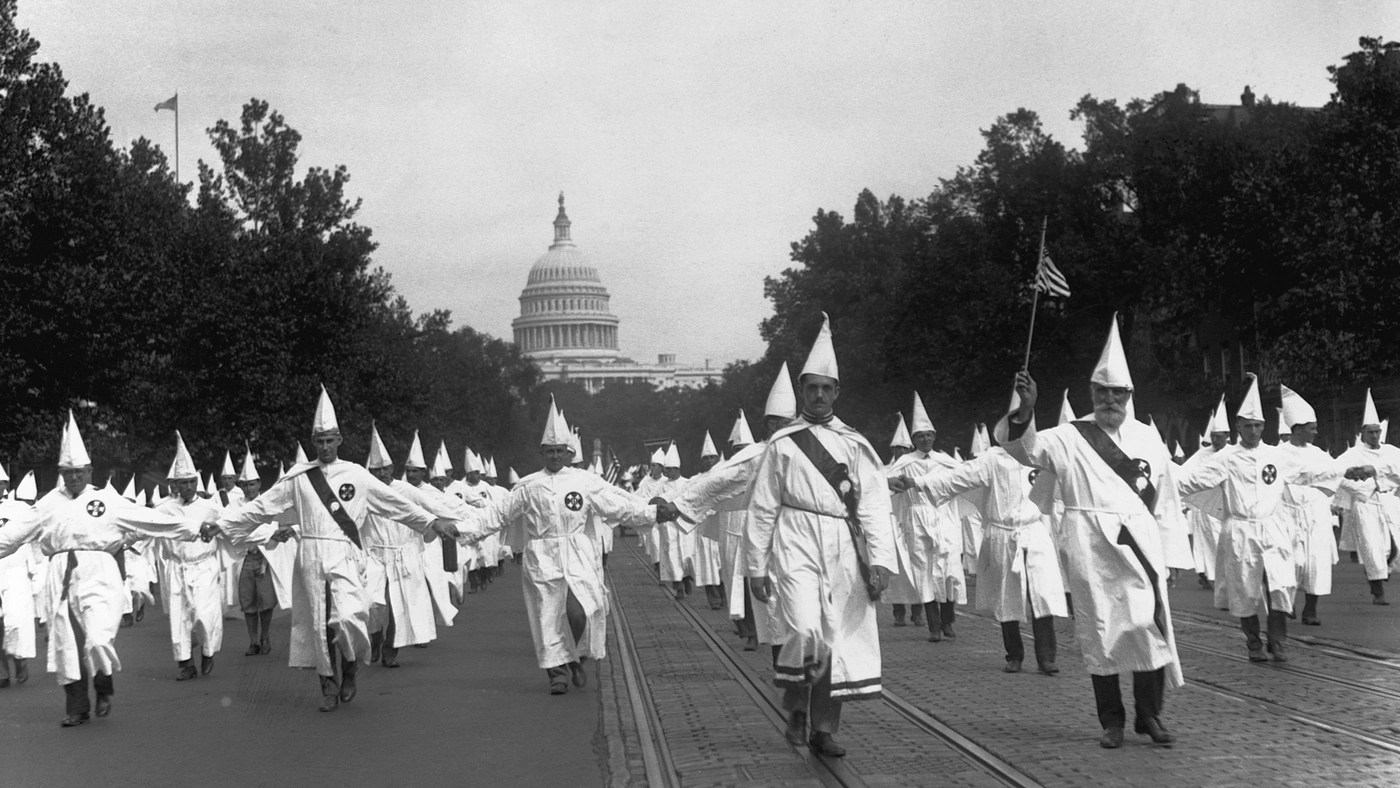
August 8, 1925. (Bettmann/Getty)
The article recounts the KKK’s 1925 attempt to appear legitimate on a national stage and the varied responses it drew. Some Black newspapers condemned it, others ignored it, and most politicians remained silent, while onlookers watched in uneasy disbelief as the parade passed.
I grew up during the height of the civil rights and women’s movements in the 1960s and 70s, marching for equal rights. Over time, courts and new laws affirmed that these rights were consistent with the U.S. Constitution. The promise that “all men are created equal” came to be understood as applying to everyone as being equal under the law.
I understood then, as I do now, that we were still an imperfect nation with work ahead of us. Even so, it felt as though we were moving in the right direction, and that gave me a steady sense of hope. Like Dickens’ Pip, I—and many others across the country who supported these changes—believed we had reason for great expectations.
Most people view the KKK image with sorrow and resolve, ashamed that such behavior was once seen as “ordinary.” Though those who marched held a different vision, most Americans today reject it, recognizing that era as a stain on our history.
My paternal Irish Catholic grandmother, born in 1907, lived through immense change in America—two World Wars, Korea and Vietnam, and the rise of modern life. Never especially optimistic, she was a constant worrier who chewed her fingernails until they bled.
My maternal grandmother, a German Methodist, was also a worrier but channeled it into advocacy, spending her life fighting for those without a voice. A steadfast champion of the underdog, she embodied “Whatever you did for the least of these.”
These larger‑than‑life women shared a concern about the world’s accelerating pace. As they aged, everything felt faster and more overwhelming—travel, news, and information—while children seemed to grow up too quickly and people less attentive to one another.
Sociologists and historians note that nearly every generation believes it lives in uniquely turbulent times. Many assume their lives are more demanding than those before them, convinced they alone face an unprecedented “madness of modern life.”
Both grandmothers died before the rise of the internet and cell phones, and I can only imagine what they would make of today. Circumstances and technology change, but each generation’s “madness of modern life” soon becomes ordinary, as it always has.
The question is …what is “ordinary” for each generation?
Ordinary today means constant connection—to social media and instant global news—along with self‑driving cars, distant wars, and countless remedies promising relief from nearly every anxiety or discomfort.
There are many understandable reasons why so many of us live with what might be called an “ordinary” level of anxiety today. If someone responds to a person struggling with clinical anxiety with condemnation, that reaction says far more about the accuser than about the one who is suffering.
Anxiety and depression are among the most common mental health conditions affecting adults in the U.S. In a 2019 study, 6 percent of surveyed adults reported moderate to severe symptoms of anxiety, and 7 percent reported moderate to severe symptoms of depression.
While life naturally includes its share of ups and downs, an estimated 280 million people worldwide live with clinical depression. In the United States alone, nearly 1 in 5 adults experiences it. Residents of West Virginia, Kentucky, Tennessee, Arkansas, Vermont, Alabama, Louisiana, Washington, Missouri, and Montana live in the ten states with the highest rates of depression in the country.
Clinical depression is a serious mental condition and should be treated with professional help. But what about those of us who feel weighed down by current events without meeting the clinical threshold? When we stand by, feeling powerless as the world seems to shift in ways we could not have imagined just months ago, where do we find hope?
A few practical suggestions may be helpful here—simply some habits I’ve tried to cultivate. I make no claim to mastering the realm. Like many of you, I still find myself frustrated at times, muttering sharp remarks at the television, computer screen, or myself with a few F-bombs thrown in for effect.
Marcus Aurelius created a guide for living well amid his era’s turbulence—a discipline for enduring the “madness of modern life.” His Meditations has long offered wisdom to those seeking not just to survive, but to live more grounded and purposeful lives.
Focus on Only What You Can Control
Stoicism centers on focusing on what we can control and accepting what we cannot. Worry may feel like action, but it rarely helps—especially when events lie beyond our influence. Without meaningful action, talk and wishful thinking accomplish little.
It’s not that we don’t care—far from it. We care deeply. We simply try to direct our time and energy toward what is actually within our control.
The one thing we can truly control is how we respond to what is happening around us.
- We can’t control the way our parents still treat us like a child, but we can control how we react to them
- We can’t control the way the teacher seems to favor some students over others, but we can control how we react to the teacher and those students
- We can’t control what politicians say or do, but we can control how we react to them
- We can’t control what our friends say or do, but we can control how we react to them
Like the rest of the world, we can join the chorus describing the waves rising over our heads. Or we can choose to let these challenges strengthen our character and deepen our resilience, helping where we are able.
“The chief task in life is simply this: to identify and separate matters so that I can say clearly to myself which are externals not under my control, and which have to do with the choices I actually control.”
Focus on the Things That You do Well
Living this way is not passive. It does not mean withdrawing from the world or pretending the turbulence isn’t real. It means choosing where to stand within it. Once we begin to focus on what is within our control, another question naturally follows: what, exactly, are we meant to do with that control?
One of the common mistakes we make that adds to our angst is “the pivot.” Basketball players and their fans use this word daily. It is the act of quickly changing direction to confuse or outmaneuver a competitor. But pivoting to something other than the things we are good at can often be a mistake.
“Stay in your lane” is a common phrase we use when someone speaks beyond their expertise. An economist may understand complex markets but not necessarily how people respond during a financial crisis. While expertise matters, communicating those ideas well may call for different skills.
Accepting what we are good at and knowing our limitations is part of the Knowing Thyself process. If we refuse to pivot we are less likely to find ourselves in-over-our-heads. Trying to explain things we are incapable of doing causes undo stress.
Focus on Holding Fast to Your Values
“It takes a special talent to betray an entire worldview without missing a beat”
George Packer The Hollow Men, The Atlantic, May 2025
Mr. Packer’s articles alone are worth the price of a subscription to The Atlantic, where he serves as a staff writer. He is also the author of The Unwinding: An Inner History of the New America and Blood of the Liberals.
In Blood of the Liberals, Packer explores his family’s roots. In the final chapter, he reflects on why people continue to hold liberal values, even when their individual efforts feel futile. Though published in 2001, the book’s conclusion remains strikingly relevant to today’s political climate.
We are living in a time when some seem indifferent to democracy. Packer’s work offers a sobering reminder of why we must not abandon our ideals.
It is Packer’s story in The Atlantic, cited above, that prompts me to write. He offers a sharp critique of Republican leaders and what he sees as their shifting positions. Figures such as Rubio, Johnson, and Graham—long identified with conservative principles—appear, in his view, to have moved away from some of their earlier convictions.
In what Packer describes as a climate of deference to Trump, some leaders appear to say and do things at odds with their earlier ideals. As an example, he points to what he sees as a striking reversal—from supporting Zelensky and the Ukrainian people to offering strong backing for Trump and Putin. In his view, this shift reflects a desire to maintain favor by echoing Trump’s positions.
You may disagree, but whatever we think of these three men, they are human. It is reasonable to imagine they experience some inner conflict. When they repeat Trump’s words, it can seem as though they are setting aside their own convictions. Politicians often adjust their language to suit different audiences; such flexibility is part of political life and is frequently expected.
You and I may never be asked to show that kind of loyalty. Still, the pull of despair and frustration can be strong enough to leave anyone feeling hardened or bitter.
It can feel overwhelming to watch our country, the wider world, and the people we love shaped by forces beyond our control. The rise in anger and the questioning of the values that have sustained this democracy for decades is deeply concerning.
We make the image of those marchers troubling again by preserving the spirit of a free democracy—one America has long sought to uphold: a nation of laws, where people are treated equally, free to pursue liberty, and welcoming to those who seek opportunity and happiness.
It takes courage to stand up to political movements that seem to set aside the traditions of a liberal democracy built over many decades. It also requires steady resolve to step back from the distractions of what can feel like a “maddening modern life.” And it takes persistence to focus on what is within your control and on the work you are best equipped to do.
Leave a Reply