
(7 minute read)
Game Over?
Before we Leroy Jenkins the whole gaming community let’s take a step back.
In his book, Mediated – How The Media Shapes Your World And The Way You Live In It, anthropologist Thomas De Zengotita details our transformation. We have moved from a species that has historically been tribal and community minded. Now, we are mostly isolated with very little ties to our local communities.
Prior to the Industrial Revolution, everyone was part of a smaller community. With textile mills and the proliferation of steel making people left the farm and began to congregate to larger cities.
Being tribal meant everyone knew each other, everyone had a place, and everyone had a purpose. For better or worse, there was a sense of belonging, purpose, and connection. This feeling is still deeply engrained within our DNA and survival instincts.
According to De Zengotita the one tool that is used to replace those connections are the media platforms we use.
Building on Canadian philosopher Marshall McLuhan’s conception of mediation, De Zengotita posits we experience reality through some form of “machine.” This machine exists between ourselves and the natural world. Seeing the world through that machine creates an alternate reality.
One example is in the world of travel. Tourists spend countless hours recording their experiences. Cameras or smartphones buffers users to their natural surroundings. We can’t help but interpret the world and our place in it through that view screen.
“The issue,” De Zengotita writes, “is no longer representation versus reality, phony versus authentic, artificial versus natural …there is no going back to reality …we have been consigned to a new plane of being …a place where everything is addressed to us, everything is for us, and nothing is beyond us anymore.”
De Zengotita, too, thinks that reality is broken.
Who’s On First?
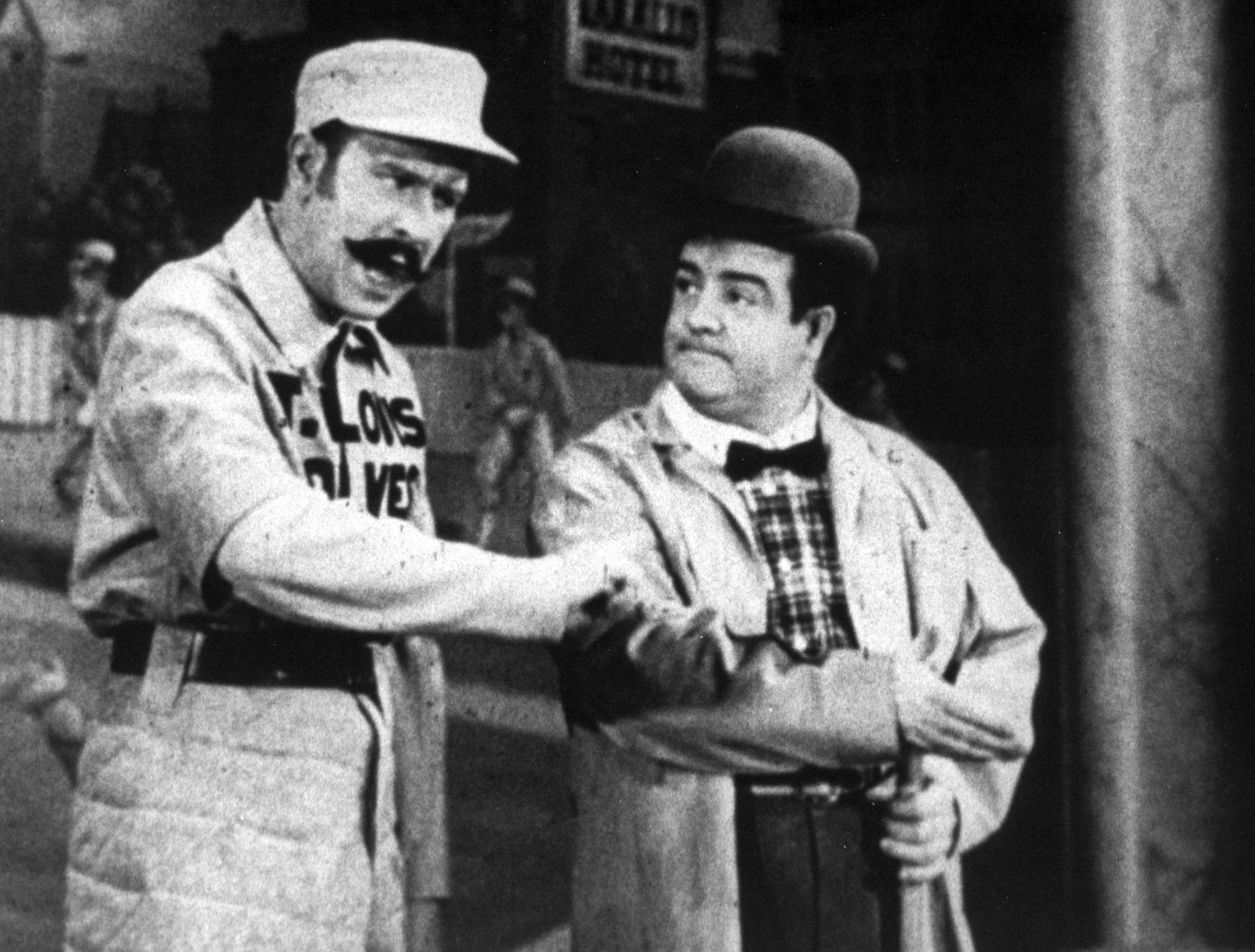
In the famous Who’s On First skit, comedians Bud Abbot and Lou Costello performed a gag nearly 80 years ago. The humor hinges on two realities. These realities are the names of baseball players and our familiarity of the English language.
Abbott: Well Costello, I’m going to New York …the Yankee’s manager, gave me a job as coach [and you are coming along with me].
Costello: …f you’re the coach, you must know all the players.
Abbott: I certainly do.
Costello: Well you know I’ve never met the guys. So you’ll have to tell me their names, and then I’ll know who’s playing on the team.
Abbott: Oh, I’ll tell you their names, but you know it seems to me they give these ball players now-a-days very peculiar names.
Costello: You mean funny names?
Abbott: Strange names, pet names…let’s see, we have on the bags, Who’s on first, What’s on second, I Don’t Know is on third…
Costello: That’s what I want to find out.
Abbott: I say Who’s on first, What’s on second, I Don’t Know is on third.
Costello: Are you the manager?
Abbott: Yes.
Costello: You gonna be the coach too?
Abbott: Yes.
Costello: And you don’t know the fellows’ names?
Abbott: Well I should.
Costello: Well then who’s on first?
Abbott: Yes.
Costello: I mean the fellow’s name.
Abbott: Who.
Costello: The guy on first.
Abbott: Who.
Costello: The first baseman.
Abbott: Who.
Costello: The guy playing…
Abbott: Who is on first!
Costello: I’m asking YOU who’s on first.
Abbott: That’s the man’s name.
Costello: That’s who’s name?
Abbott: Yes.
Costello: Well go ahead and tell me.
Abbott: That’s it.
Costello: That’s who?
Abbott: Yes.
It is the classic misinformation gag where people communicating are using the same words but with different meanings.
For Abbot, Who is a subject noun and he is playing first base.
For Costello, who is an interrogative noun used for obtaining specific information, like a name i.e., “Who is he?” or “Who is responsible for this mess?”
This bevy of misinformation through miscommunication fueled great vaudevillian comedy. It has also been fodder through the golden age of television and beyond.
What happens when the stakes are not comedic but more important? Citizens of a democracy may have two competing definitions of realities, like it seems we do now. These definitions vie for the soul and future of that society.
Hard to get a laugh out of that.
It is what philosopher and neuroscientist Sam Harris calls “a crises of meaning.” People are spending so much time getting information from competing outlets. These outlets may provide a worldview that may or may not be grounded in reality.
“We need to have an open ended conversation with 8 billion people,” says Harris. “What makes that difficult is the level of political fragmentation and extremism and partisanship born of our engagement with new technologies. Born of the fact that we just simply can’t agree about who is lying most of the time, who is misinformed, who is in possession of only half the story?”
The greatest question we are facing right now as a society, Harris believes, is what do we do about that?
The first Principle of Discovery is that you must not fool yourself and you are the easiest person to fool.
–Richard Feynman, Cal Tech commencement speech, 1974
Democracy depends on two variables, according to Tom Nichols author of The Death of Expertise and Our Own Worst Enemies.
In Enemies, Nichols laments the fact that knowledge and behaving ethically towards our fellow citizens are in short supply. Knowledge depends on not just collecting facts and figures but also the agreement on the basic meanings of those facts. Over the years that has become almost impossible for reasons mentioned above.
There has always been a segment of our population that never saw the value of learning. They even go so far as to be suspicious of anyone in the pursuit of it. Conspiracy theories about fake moon landings, a flat earth, and lizard people walking among us are the result. Social media is the biggest megaphone in its reason for spreading.
We are experiencing one of the greatest technological booms. The answers to any question are available at our fingertips 24/7/365.
It is one thing to wonder aloud about whether Oswald worked alone in the Kennedy assassination. Using the same cynicism to ponder the existence of Bigfoot, Loch Ness, or Jewish space lasers is too far.
The second thing missing in our society according to Nicholes is behaving ethically towards our fellow citizens. Spend an hour on any social media platform and you’ll witness the toxic communication between groups of people.
Ignorance and lack of decency are a lethal combination enough to anesthetize any type of cooperation in a democracy. Of course, countering this requires that citizens commit to factual reality. As for decency, where are the Joseph Welch’s of our generation? At this point we seem to be so far out to sea that land is nowhere in sight.
In order to turn things around, adults need to stop acting like children living in adult bodies. This greedy need to give have a winner-take-all mentality is not helping. But for far too many, the lure of a pseudo-empowerment is too intoxicating. One political ideology burns another with a scathing social media post. It is nothing more than performative art and politicians are rife with it these days.
We have an unserious segment of our society. They are more interested in turning everything into a WWF cage death match. Or a bad reality episode of Housewives of Who-The-Hell-Cares! We can be better citizens by giving up false perverse empowerment. This toxic mindset comes with wanting to watch democracy and its institutions burn to the ground.
Eventually this kind of behavior will run its course. If history has taught us anything it is that people will eventually become bored with it. They will move on to the next thing. Let’s hope, instead, that we grow up and become serious citizens once again before it is too late.
