
(10 minute read)
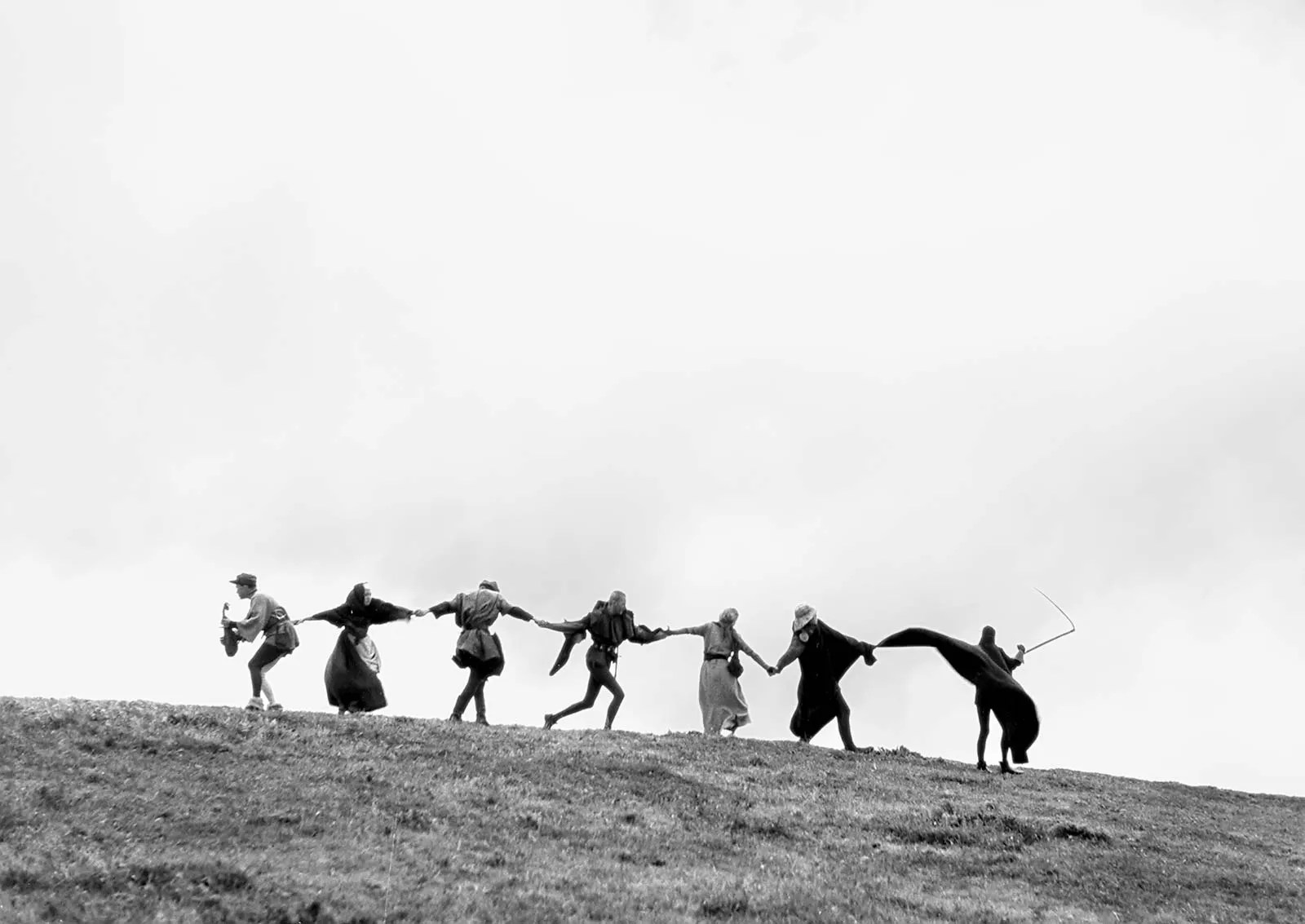
The Seventh Seal, Ingmar Bergman, Svensk Filmindustri, 1957
Swedish filmmaker Ingmar Bergman wrote and directed The Seventh Seal. Many consider it to be one of the finest films ever made. Bergman himself admitted that it is one of his most personal. The “demons” that tormented him are portrayed bigger than life on the silver screen.
The meaning of life and death is explored from beginning to end in this eerie 96 minute masterpiece. It also delves into an absentee god, religious fervency, and the cheapness of human life. The movie portrays an array of characters, each a very different person from the rest.
However, each of them had a very common belief and that was trusting in something that provided comfort. Life had battered them harshly. The beliefs they adhered to no longer brought them comfort. The hope and peace were also gone. Each are now independently faced with the dark abyss of uncertainty.
I dare you to watch it and tell me it didn’t change you in some way. It is a 90 plus minute master class in what happens when our comfort beliefs begin to fail us. It is a staggeringly sobering motion picture.
Among other bits of cinema, I used this movie in a 200-level college course. The course was called, Science, Religion and Philosophy in the Matrix Trilogy. The course description read; “exploration of the meaning of knowledge, reality, consciousness, freedom, fate, good, and evil. It includes faith and enlightenment, and the very meaning of existence. The Matrix movies are used as a springboard for discussion.”
“The very meaning of existence” was the key to this class. From day one, I challenged the students to engage in the course. I promised them two outcomes if they did. One, they would walk away from the course exposed to considerations about worldviews (beliefs) and how they worked. Two, they would walk from the course only more secure in knowing why they prescribed to a particular worldview (belief).
My intention was not to conform them. I wanted them to understand how and why they believed the things that they did. Of course, we were exploring human comfort beliefs. We examined what they were and where they came from. We also looked at how they developed and why we believed in them. All humans share a common nature. We need to make sense of this world. Everyone does this to one degree or another.
And I have written an awful lot about comfort beliefs.
This.
And, of course, let’s not forget the whole series on Christian comfort beliefs.
I have written a lot about the beliefs that bring us comfort because I have spent a lifetime studying them. The term “comfort beliefs” may be new to some. However, it is a common phrase that I use to explain why humans do some really weird shit.
I do not think I came up with the phrase “comfort beliefs.” I wish I could remember where I picked it up. Then I could cite the inspiration for using it. At any rate it is a phrase that explains a lot.
Feelings are a powerful emotion. Especially to us Americans, who tend to allow our feelings take precedence over logic or reasoning. The phrase helps to define what is internally happening to us. This occurs when we clutch at our beliefs.
For example, it is rare, but I have engaged in conversations with individuals about my doubt on the afterlife. The common reaction I get is one of shock. I see the person begin to process the idea. It becomes too much for them. Without living and believing in a system of rewards and punishments, what is the point? is the usual question that comes back.
It is clear that their comfort belief is being assaulted and they feel the threat is very real. In the Matrix course we would discusss such things, the beliefs we adhere to and why. Because the assignments were set up to be mostly self-reflective, in-class discussions were quite spirited.
The one thing I am most proud of is that, despite the topics we covered, heated arguments never broke out. The current climate of our country concerns me. The proliferation of social media and the comments there adds to this concern. Today, I am not sure I could teach this class while guaranteeing a calm classroom. Though I would LOVE the challenge of it. I would like to think I could get both sides to think about their staunchness.
It is a shame. There are too many unwilling to listen and only too willing to impose their comfort beliefs on others. For example, today there is a minority of white christian nationalists. They have hi-jacked the national dialogue about the future of our nation. Their intolerance for accepting contrary beliefs is the highest I have ever seen.
They may invoke all the trappings of being a Christian but have NONE of the characteristics, i.e., tolerance, patience, and empathy, of the One they venerate. Their interpretation of the gospels are short of nothing but perverse. They completely disregard Eastern traditions and practices. They interject a layer of Western mindset onto the gospels that was never intended. It’s as if they think the gospels were written in Chicago!
The First and Second Testaments were written in the Middle East by Middle Eastern people. When one considers that fact, they take on a richer, vibrant, and whole new deeper meaning. They are missing that very important point.
Admittedly some of the reaction from these nationalists stems from what they think is coming from the far left. Most of their motivations are driven by a craven idea. They mistakenly believe they are truly an oppressed people.
Please, someone point out a scripture where Jesus lamented about being oppressed.
If you come at me with the Garden of Gethsemane, I am going to send you back to Sunday school. You can start all over again!
The determination to buy-into a belief system that guarantees absolute power is strong. Their absolute certainty in their assumptions about being right matches this determination. Without knowing it, the Kruger-Dunning Effect is astonishingly strong with this group. In their “certainty,” they feel all the more powerful. But if you listen to them they really are only espousing a “victim mentality.” THEY are the ones being assaulted for their comfort beliefs.
Ballsy of me to be so harsh, yes? Lest you forgot I counted myself as one of them for nearly a decade in the 1980s.
Imposing Comfort Beliefs On Others
It is one thing to genuinely want to figure out the world in which we live. We also strive to develop beliefs. These beliefs provide us with the comfort we think we need to fight off any uncertainty. You know, to search for meaning and purpose?
But when that search leads people to impose their comfort beliefs, it becomes problematic. Demanding how others should live their lives based on YOUR values is not only wrong but also dangerous. How dangerous?
The recent Supreme Court’s (SCOTUS) convoluted decision demonstrated this. It provides “presumptive immunity” to past and future presidents. The courts are declared the arbiters of this immunity.
“The court gave itself the power to determine which actions can be prosecuted and which cannot by making itself the final arbiter of what is ‘official’ and what is not. Thus any action a president takes is subject to review by the Supreme Court.”
Heather Cox Richardson, Letters From An American, July 1, 2024
For the first time in American history, there is a decision by the highest court in the land. It states that someone can actually be above the law. And that flies in the face of nearly 250 years of a Constitution that said otherwise.
SCOTUS has a questionable record in their recent decisions. Can anyone believe this court would give a Democratic president the same leniency on immunity? Would a Republican garner more leniency?
This court has shown that their decision is really not coming from an interpretation of the law. That is dangerous. Instead, it is coming from a group of people that demand THEIR comfort beliefs on others.
“A rule of judicial humility gives way to a rule of judicial hubris [excess of confidence]. In one fell swoop, the majority today gives itself exclusive power over every open issue—no matter how expertise-driven or policy-laden—involving the meaning of regulatory law.”
Justice Elena Kagan, dissent on the ruling overturning Chevron deference, 2024
Justice Kagan’s warning that the comfort belief …we are right and anyone not in agreement is wrong …is chilling. By the way, the “we” is less than 35% of the US population. The majority of Americans strongly reject these actions. They disapprove of how a small group has imposed their archaic values on the rest of the country. And, yet, the Republican Party continues with their power grab.
“By the way, the United States is not a democracy. Do you know what a democracy is? Two wolves and a sheep deciding what’s for dinner. You don’t want to be in a democracy. Majority rule: not always a good thing.”
House Speaker, Mike Johnston, during a 2019 sermon at First Baptist Church, Haugton, Louisiana
As shown by the Speaker’s comments, comfort beliefs provide a sense of being in control. They offer a false sense of security against uncertainty. Uncertainty is a powerful negative emotion that makes us say and do some weird shit. It explains why people choose politicians despite it not being in their best interest.
We are discussing ideas found deep in the psyche of individuals. It is difficult to provide an explanation for why each individual buys into these ideas. Lest you think I am being an alarmist about this let me provide you with one more example.
Recently, the self-proclaimed #1 supporter of former President Trump, Wisconsin Representative Glenn Grothman gave a speech on the House floor. He accused “the angry feminist movement” of emasculating men. He said the U.S. should “work our way back” to 1960 if former President Donald Trump wins in November.
Grothman also went on to say that President Johnson’s war on poverty was really a “war on marriage.” He claimed it was a communist attempt by the government to take control of children’s lives.
In reality, the Johnson administration impacted millions of Americans. It helped CONGRESS pass the 1964 Civil Rights Act and the 1965 Voting Rights Act. These laws provided equal protection of the law to Black American citizens. They also guaranteed the right for them to vote.
Grothman wants to erase six decades of progress and equality. He aims to return to a time when a few white, wealthy, privileged males controlled society. The world for people like Grothman is looking a little too Brown for their liking. This is apparent even as far north as Wisconsin.
This kind of imposing of comfort beliefs in my opinion is insidious and evil. There was a time when leaders of the Republican Party would call out this kind of extremism. They would denounce it as too extreme.
Not any more. What was once considered a bug is now a feature.
There is one thing to be certain that the Grothman example shows. The more bravado we use in our speech, the less we feel secure on the inside. The greater the fear, the greater the bravado. The darker the fear, the darker the bravado. We don’t show strength with the facade of bravado. We show weakness.
Anyone who took a 101 psych or speech class can tell you that.
They say death and taxes are the only things that are certain in life. Death certainly is. I’m not sure about taxes given how many of us get away without paying them. I would replace taxes with uncertainty. Though death is about as uncertain as one can get.
It is because of facing death and uncertainty where we develop the need to create comfort beliefs. And that desire to create or grasp onto them is embedded deep into our DNA. It’s the internal stuff left over from our ancestors. They huddled in caves and looked into the vastness of space on a clear midnight sky. They watched helplessly when their loved ones might have been eaten by lions, and tigers, and bears.
Oh, my!
We no longer face the same daily threats. However, developing elaborate comfort beliefs to stave off the sting of death and uncertainty remains the default human position. And yet no matter how sophisticated the beliefs they never seem to fully alleviate those fears.
One viewing of The Seventh Seal will convince you of that.
