
(8 minute read)

(From the previous post): The scriptural passages noted do not refer to a literal place called hell. Jesus never presented any evidence for its existence. What we think are references to hell in the Second Testament are not representative of any eternal punishment after death.
Add any attempt to crowbar the concept of hell into a translation of the First Testament are Christians weak attempt to:
- Validate the existence of the Christian faith
- Co-opting (a nicer word, but hijacking or stealing has the same meaning) of Hebrew scriptures for the advantage of elevating the Christian faith as the “TRUE” faith
Both have created horrendous consequences over the centuries where human beings have justified the cumulative killing of countless others.
The Point of the Myth of Hell
Does it seem that I’m being heavy handed in my judgment of the Church’s mythical creations of hell?
If hell is a human construct intended for the help of the faithful, then we should consider its purpose. Let us give the creators the benefit of the doubt. For a few moments let us assume that nefarious intentions are not at play.
Hell is a human construct that slowly emerged throughout the centuries. This is a fact.
The first impetus and overall development of the afterlife is an effort by ancient cultures to answer the question …why do bad things happen to good people?
The question needed to be addressed.
If God is all loving, knowing, powerful, charitable, and a fair judge …why would he allow bad things to happen not only in the world but to his followers, as well?
“Houston we have a problem” …the problem of evil, bad people are doing bad things and what is their punishment for that behavior?
The first century church had not faced this conundrum yet. They were under the impression that God was going to set up a kingdom on earth any day.
So, the message was to encourage the faithful to have heart. Jesus is returning shortly and all will be made right. Except he didn’t return shortly. Months turned into years that turned into decades, it became pressing to develop an answer to the problem.
As the years went by converts to the Christian faith were no longer coming from the Jewish community. They were Gentile cultures. And this would have a profound impact on the faith.
Gentiles like Martyr, Origen, and Augustine were later venerated as the most prolific writers of the early church. All three are considered the most influential theologians of the first three centuries. They integrated many of the Greek philosophies into Christianity.
What eventually developed was an elaborate myth of the afterlife that would involve a system of rewards and punishments.
There is ample evidence that the construct of heaven came first. The construct of hell followed much later over the centuries.
The logic for the existence of hell went something like this. If there is a reward for remaining true to the faith, then there should be a just punishment. This punishment goes to those who are not faithful. This punishment applies to those that would do “evil.”
Classical Greek thought determined that people were born possessing two entities, a body and a soul. The soul needed to “go somewhere” after separating from the body after death. Hell is the opposite construct of heaven. Evil doers are punished in hell, whereas the faithful are rewarded in heaven.
Marching to Dante’s Inferno
Each of the gospels frame two very important messages using language that eventually will be weaponized by later Christian generations.
First, the cosmic battle between Jesus and his followers against the unseen forces of evil.
Second, the human battle between followers and the various groups the author’s considered enemies of Christ.
As the pews became filled with more Gentiles, converts used the themes and language they found in their new faith. They directed these themes and language against other pagan enemies and heretics.
“Christians in later generations turned weapons forged in first century conflict against other enemies. But this does not mean that they simply replaced one enemy with another. Instead Christian tradition tended to accumulate them.
For example when pagan convert Justin Martyr aimed vocabulary concerning Satan against Roman persecutors and against heretics, he took for granted the hostile characterizations of the Jewish majority they found in the gospels.”
Elaine Pagels, The Origins of Satan
The propaganda Martyr found in the Christian faith was empowering to a marginalized individual. It is still empowering today to millions of Christians.
Martyr’s enemies became God’s enemies. God’s enemies became Martyr’s. Martyr used this new language of condemnation. He justified his actions against his perceived enemies.
It is important to make this distinction about positioning and language. This distinction would serve as the foundation for later generations to construct their myths of a literal hell. Martyr is only one of many over the centuries.
It took five centuries for the myth of hell and the devil to begin to emerge. Over time some elements were lost, others added as communities and thinkers competed for influence of Christian thought.
The earliest pictorial illustration of Satan appears in the sixth century CE. The Rabbula Gospels, a brightly illustrated Aramaic manuscript, depicts this through an exorcism.
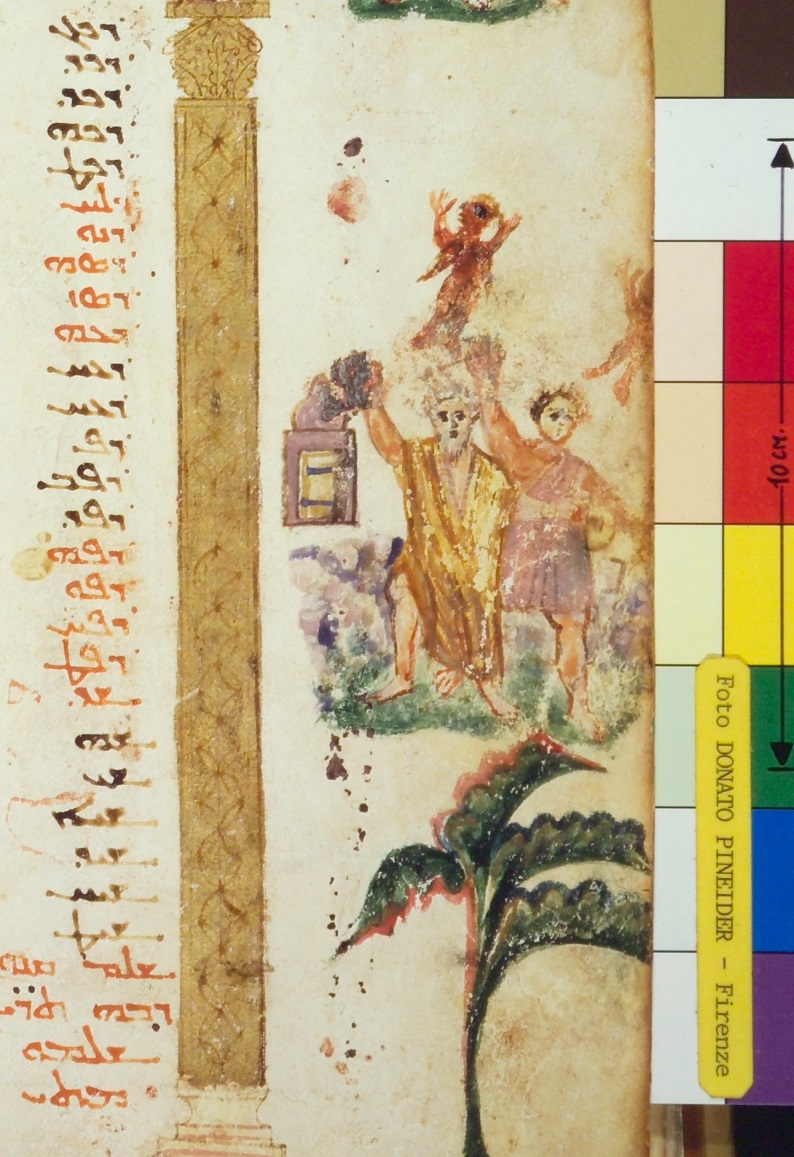
Jesus casting out demons, Rabbula Gospels, 586 CE
That’s not to say that illustrations hadn’t existed before then and were lost. We just do not have any evidence of their existence. The existence of illustrations coincides with the emergence of this part of the Christian afterlife myth. This timing is significant as it becomes established doctrine.
“Abandon all hope, you who enter here.” –Dante,
The Divine Comedy, inscription found on the gates of hell
The fiercest proponent for the existence of hell was Augustine. He was convinced that “hell was forever” and as far as he was concerned there was no argument about it.
The Council of Constantinople in 553 CE embraced the concept of eternal damnation and it became official. Hell became a doctrine of the church five and a half centuries after the birth of Jesus.
The predominate Christian view of hell is that it is like our criminal penitentiaries. In hell, sinful and tormented souls are crammed together. They are tortured throughout eternity.
“A major feature in early Christianity” was the amount of written texts hyping the “horrors of damnation.” Texts like the “Apocalypse of St. Paul,” printed three centuries after Paul’s death, were fabricated. They often told salacious tales of hell and living to tell about it.
Common in these stories were narratives that read like gory tours of the bowels of hell.
The purpose? Christians faced persecution for their faith. Remaining faithful and dying led them straight to heaven. Abandoning the faith and dying resulted in spending a tortuous eternity in hell.
But the true artisan of hell as we know it came from Dante’s epic poem, “Divine Comedy.”
In the 14th century, Dante provided a depiction of hell. His landscape was filled with sights, sounds, smells, and lots of sighs. This work is considered one of the greatest in “damnation literature.”
The work covers three areas of the unseen world: hell, purgatory, and heaven. When the 19th century French artist, Gustave Doré, illustrated the poem, it renewed interest in Dante’s work. It influenced art, culture, and religion. Our modern interpretation of hell comes directly from this work.
Throughout Christian history, the Council of Constantinople in 553 CE contributed to evolving views. The writings of Origen, Augustine, Aquinas, Dante, Luther, Calvin, and the Jesuits also played a role. Collectively, the myth of hell would continue to evolve and grow.
It would be convenient to believe that a linear doctrine of hell has a 2,000-year history. It may seem like it was transcribed into scripture and narrated by Jesus. And convenient is what modern Christianity, particularly literalists and fundamentalists, have chosen.
But none of that is true.
This is one of those myths. It was truly built on a lie at worst. At best, it was built on conjecture.
There is no accepting by faith the concept of hell.
Faith in what?
There isn’t a shred of truth to hang onto.
The Christian mythical worldview elevated the myth of its Jewish roots. It then embellished on the afterlife myth by borrowing from ancient Greco-Roman cultures. To be a Christian is to believe in a system built on rewards and punishments. This system is built on questionable myths at best, lies at worst.
But then again, the entire history of the Christian faith stems from a willful misinterpretation of ancient scriptures. This misinterpretation often serves to proclaim a holy war against one’s enemies.
If this study on hell lead us to these conclusions, what will we discover when we examine its supposed ruler?
This figure is also considered the Western world’s most powerful symbol of evil. Names like Beelzebub, Devil, Lucifer, Baal, and Prince of Darkness represent it. It is also known as Evil One, Enemy of God, Tempter of Eve, The Antichrist, …Satan.
Read The Emerging Christian Myths, Pt. 11
Sources
- R. Allen Killen, Hell, Wycliffe Bible Encyclopedia, Moody Press, 1982
- Elaine Pagels, The Origin of Satan, Vintage Books, 1995
- Charles Panati, Sacred Origins of Profound Things, Penguin/Arkana Books, 1996
- Russel Shorto, Gospel Truth, Riverhead Books, 1998
