

Assault On American Democracy
(8 minute read)
(From the previous post) For nearly three-quarters of a century, as a nation, we have had the pleasure of living with increasing freedoms and prosperity. Has it been perfect? Obviously not. Could it be a hell-of-a lot better? Absolutely. But we, as the majority, are the ones to decide what kind of America we want to live in.
If history teaches us anything it is that we have been here before. Arguably, the good news is that our nation emerged better. Not perfect, but better.
Whether it is just plain dumb luck that we have emerged remains to be seen.
Like many of you, I was dumbfounded at the outcome of the 2016 election. Did America really hate the Democratic nominee that much? For me and millions more, the choices in a presidential election, once again, were not at all stellar. But did the American populace hate one candidate so much that they choose an obvious bombastic TV game show host? Or was the guy just that much more charismatic that it was too much for any candidate to overcome?
I am far from a pundit and a lot smarter real pundits asked and answered many more questions. It’s human nature to do so especially when the outcome of something is so stunning.
How could this have happened? is probably the most asked question in the history of mankind. We have survived as a species because we have asked this question. The question secured a safer future. If we could figure out how not to have this happen again …well, you get the point. Those species unable to ask and answer that question …well, you get the point again.
After thinking that a correction of what happened in 2016 came in 2020 all that was behind us now. The fluke had been corrected, right?
So here we are, in 2025, full of questions again. Except they are more serious because evidently 2016 wasn’t the fluke. 2020 was. Now, it’s not only universities that are in crises but every democratic institution is feeling the shock.
The Trump presidency, both 1.0 and 2.0 has been, how would one put it diplomatically? …chaotic. One week to the next, what am I saying? One day to the next. No, one hour to the next …he has governed in a way that makes Alice in Wonderland feel like a Tuesday afternoon picnic.
He is going to do this, he is not going to do that. America first. He likes this person, no he doesn’t like them anymore. Make America Great, America first. Make America Great Again. America first. Everything is big, beautiful, a witch hunt. America first. Hoax, believe me, brightest mind, I know a lot of words, America first, inject bleach into their…, build the wall, America first.
Observers will begin to see a pattern.
America First Movement
In 2016, after sweeping five primaries, Republican candidate for president, Donald Trump, revealed his America First policy. “America first will be the overriding theme of my administration,” Trump said. With that statement Donald Trump tapped into some of the darkest traditions of American politics.
Eighteen months later his America first ideals were on full display in Charlottesville, Virginia. Charlottesville became a magnate for the White supremacy groups. The city had been debating for some time over what to do with a statue of Gen. Robert E. Lee. The General had led the Confederate army during the Civil War.
Cities across the country had similar struggles with what to do with their Confederate statues. Some felt that they were reminders of a dark time of racism in U.S. history and should be taken down.
Earlier in 2017, the Charlottesville City Council had voted to remove the Lee statue and rename the park where it is located.
During the rally, 1 person was killed and 19 others injured. White nationalists and Neo-Nazis had marched with tiki-torches the night before chanting the Nazi-associated phrases “blood and soil” and “you will not replace us.”
It may not seem it to some, but we’ve been here before.
America First is a political ideology that is nationalist and populist addressing concerns that are both foreign and domestic. In it’s simplest form it is the isolationist, protectionist, selfish idea that American interests are above all others.
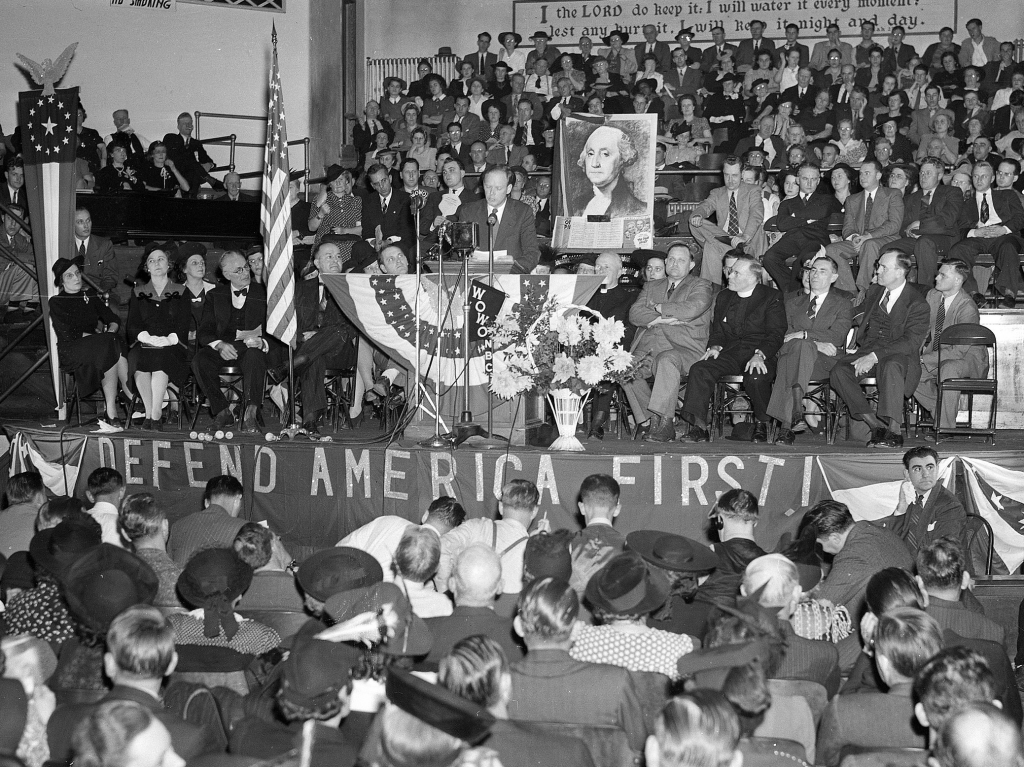
The most prominent time for the America First movement were the years between the First and Second World War. While America First ideals were espoused by politicians to stay out of both wars, the movement thrived during that period.
Foundational to their arguments were the “lessons learned” from the first Great War. Most of those “lessons” were nothing more than biased views. Attempts at re-writing history to fit their mold. Further arguments included trade balances, protectionism of American industries, and the desire to stay out of future foreign conflicts.
In 1940, a group of Yale law students founded the Emergency Committee to Defend America First. The name was eventually shortened to the America First Committee (AFC). It soon became “one of the largest foreign-policy lobbying organizations ever to have formed in the U.S.” At one point AFC had hundreds of chapters across America with nearly a million members.
Some of its inaugural members at Yale were a who’s-who of future prominence. A Yale president, a Supreme Court judge, an American president, and a leading conservative publisher. Their main motivation, they said, was to “keep America prepared for war but away from any conflict.”
At first, AFC attracted many allies from every political persuasion, left, right, and in-between. Another impressive list of who’s-who. Because of this diverse attraction, leadership went out of their way not to alienate any of their constituents. Those first “attempts to thread the needle contrast sharply with what its going on today.” (Nichols)
At some point, however, the Committee went off the rails. Most historians point to a speech given by the famous aviator, Charles Lindbergh, who was now “the face” of AFC. In September of 1941, he delivered a speech in Des Moines, Iowa. Writing and delivering the speech himself, it was anything but threading a needle.
Dripping with anti-Semitism, Lindbergh emphatically stated that the “Jewish race” was trying to pull America into the war. Hinting that Jews were not considered American they were doing so for “reasons that were un-American.” He warned the “Jewish race” that tolerance for them would not survive if America were pulled into the war. In a chilling not-so-veiled threat he warned they would “be the first to feel the consequences of intolerance.”
While some had suspected, it wasn’t widely known before that speech. Lindbergh had become a Nazi sympathizer. Now, there was no doubt.
The speech was met with outrage. Politicians, newspapers, affiliations, and many members of the organization called on the AFC to renounce Lindbergh. Instead, they doubled down and churned out press release after press release causing more controversy. Family members publicly opposed his views. Organizations of every type were no longer willing to be affiliated with him. “His name was even removed from the water tower in his hometown.”
Many years later, internal documents reveal leadership in the AFC at that time were in direct conflict with one another. In the end, they brazenly denied that Lindbergh and the organization was anti-Semitic. They used the controversy to push their agenda and smear dissenters. Critics, they said, were only interested in discrediting the organization and it’s anti-war message.
After fully embracing a racist and anti-Semitic stance, AFC never recovered the middle ground. Future public statements and speeches continued on the path that Lindbergh had started. AFC would thus always be known as a nationalistic, xenophobic, anti-globalism organization. In fact, they believed American interventionism was a far greater threat than German Nazism, Italian fascism, or Japanese militarism.
Despite their unwavering sordid ideals, polls showed that a majority of Americans agreed with their anti-intervention stance. Americans did not want to enter into another world-war. However, any solace they felt by the polls would be short lived. Ten weeks after the Des Monies speech, the Japanese bombed Pearl Harbor on December 7, 1941. The anti-war sentiment was doomed and came to an end.
Over the years, a majority of the original leadership of AFC would be remorseful of their work on the Committee. The hateful path the organization took was not what they originally envisioned. History was kind to those that renounced the hate. It would not be so kind to the AFC movement as a whole.
Read The University In Crises, (Pt. 10)
Sources:
- Sarah Churchwell, Behold America. The Entangled History of “America First” and “The American Dream,” Basic Books, New York, N.Y., 2018. The influence of Churchwell’s work is felt throughout this article.
- Christopher Nichols, America First, American Isolationism, and the Coming of World War II Essay, Passport, September 2018
