
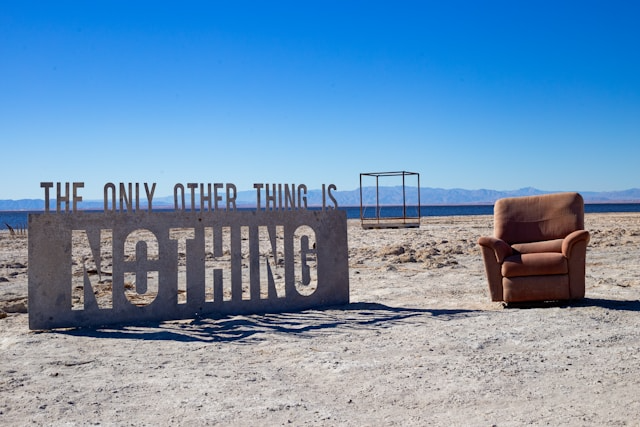
(Photo by Remy Hellequin on Unsplash)
Perspective Is Everything
(9 minute read)
Key Takeaways:
- Perspective shapes experience more than circumstances do. What feels overwhelming or unfair often depends less on the situation itself and more on how we choose to interpret it.
- Resilience is trained, not inherited. Like so many before us, we can develop the ability to endure and adapt through practice—by repeatedly adjusting how we see and respond to challenges.
- We always have agency in our response. While we cannot control many events in life, we can control how we frame them—and that choice determines whether we experience despair or opportunity.
If you have skimmed through the various posts found here, you no doubt noticed a common theme. With experience as a life long communicator in media, profit/non-profit organizations, and academia I have learned one thing. It is possible to distill everything we say and do into one simple word. And, yet, we still know very little about it though we use it all the time. You are even using it right now.
In Outer Space, No One Can Hear You…Complain?
In September 2023, Lieutenant Colonel (Lt. Col.) Francisco “Frank” Rubio achieved something no other American had ever done.
Rubio was born in Los Angeles County in 1975 to Salvadoran teenage parents. Soon after, his family moved to El Salvador, where they lived for six years. In 1981, he and his mother returned to the United States and settled in the Miami area, where they remained until he finished high school.
Choosing a military path, Rubio attended the United States Military Academy at West Point, where he earned a degree in international relations and volunteered to become a pilot. He went on to fly missions in Bosnia, Iraq, and Afghanistan.
After his tour, Rubio attended the Uniformed Services University of the Health Sciences in Bethesda, Maryland, earning a doctorate in medicine. As if that were not enough, at age 42 he was selected for NASA’s astronaut program and completed two years of intensive training.
In 2022, Rubio and two other astronauts were chosen for a new NASA mission, and in September of that year they launched to the International Space Station, where he was scheduled to spend six months. His responsibilities included overseeing a range of scientific experiments, such as work with a new space-age material called aerogel, stem cell tests related to leukemia and cancer, and studies on the effects of gravity on yeasts and bacteria.
Three months into the mission, however, the capsule designated for their return was struck by what NASA described as “space debris,” a tiny piece of orbital junk. The impact caused a coolant leak, and the capsule had to be taken out of service. Rubio and the other astronauts scheduled to return learned that they no longer had a ride home and would need to remain in space for an additional six months while a solution was arranged.
One year and one week after Lt. Col. Rubio first set foot on the International Space Station, he finally returned home, having spent a record-breaking 371 days in space. After four months of readjusting to Earth’s gravity, Rubio began speaking with various media outlets that were eager to hear about his experience.
Again and again, he was asked the same question: what was it like to live through a year filled with both extraordinary opportunity and unexpected disappointment?
Conversation about traveling to Mars has picked up in recent years, and space exploration is once again capturing the imagination of the American public. Against that backdrop, Rubio’s experience has become especially valuable and sought after.
One particularly insightful exchange took place earlier this year between Lt. Col. Rubio and NPR’s Miles O’Brien.
O’Brien asked Rubio to describe, from a psychological perspective, what he experienced throughout the year, especially when he learned his return home would be delayed. In his answer, Rubio credited his military training and experience as key factors in helping him cope with the news.
“…a lot of our [personnel] often get told, hey, you’re staying a little bit longer than anticipated. I never got extended much longer than about a month,” he acknowledged. “Psychologically, it’s really not too different, whether it’s a month or six months.”
“It’s Really Not That Different”
Lt. Col. Rubio’s admission is striking. Many of us lose patience at a fast food drive-thru window or when we’re asked to stay an extra hour at work to finish a task. We get frustrated when we have to wait for a table at our favorite restaurant, when we lose cell phone coverage, or when the internet seems a little slower than usual. And of course, many of us really lose it when our Amazon shipment is delayed 24 hours because of… whatever.
These are all minor irritations, of course. Most of us would probably hesitate to air those grievances while standing beside someone like Lt. Col. Rubio. After all, we are only human, right?
But so is Lt. Col. Rubio.
Even before his space journey, his résumé was already impressive. What he has accomplished so far is remarkable, and learning about him is genuinely inspiring.
What exactly does Lt. Col. Rubio mean when he says “psychologically it’s not that different”? It can be summed up in one word:
Perspective.
The mental stamina needed to stay in one place for six months is much the same as what is required for a full year, even if we hadn’t planned on it.
What Lt. Col. Rubio has accomplished in life is already more than many of us will ever come close to doing. Yet he would likely be the first to say that he is not superhuman or someone born with special genetics.
He credits his training for his ability to cope with change. Through that training, he has learned to look at reality as it is and adapt to the situation—in other words, to be ready to adjust his perspective in order to complete what needs to be done.
Perspective And Reality
Our perspectives shape our reality and, ultimately, what we believe we can or cannot accomplish. But the hidden truth is that the possibility of achievement exists whether we believe in it or not. Those possibilities only become real if we put in the time.
“How can I get to Carnegie Hall?” the tourist asks.
“Practice, practice, practice.”
There are no shortcuts to laying the foundation for what we hope to achieve.
We alter our perspective first. After that, the possibilities expand. People often say we can be our own worst enemy—a cliché that hides an important truth: just because we think we cannot do something does not make the possibility of achievement any less real.
If I change my perspective and decide to attempt the thing I doubted, I may very well succeed. The possibility is there whether I believe in it or not.
Which is an exciting prospect.
I do not have to pull “something” out of thin air. I only have to work toward what I know is possible.
We can learn from Rubio without spending years in the military. Anyone can begin to change their perspective given the right tools, even if at times it requires a great deal of effort.
At my home, I have a satellite dish. Occasionally, it shifts slightly out of alignment and the signal is lost. When that happens, the company has to come out to make the proper adjustments—often no more than a fraction of an inch.
I think perspective works much the same way. One slight adjustment, one “aha” moment, can bring a great deal of clarity. Conversely, being just a millimeter off can result in a lot of static.
Things happen to us from time to time, and much of what comes at us in life is beyond our control. Instead of focusing on how unfair those things may feel, what might it be like if we use our time and energy to gently adjust our perspective?
Our response can make all the difference. It influences whether we cling to the illusion that a good life is one without complications, or embrace the reality that unexpected challenges are simply part of being alive.
Of course, no one needs to go off to flight school to learn any of this. We can start now, right where we are. Through trial and error, we can begin to gain confidence and learn when to adjust or when to validate our perspective. If we adjust, it may bring the change we needed to move through that difficulty. If we validate our perspective, then we get to practice it today and see whether it still serves us well for any future disappointments.
And we know that they will come, all positive vibes and gobbledegook aside, they will happen.
Reality includes the understanding that life is sometimes full of persistent complications. American author Ryan Holiday seems to understand this power of perspective as clearly as anyone writing today.
“Where one person sees a crisis, another can see opportunity. Where one is blinded by success, another sees reality with ruthless objectivity. Where one loses control of emotions, another can remain calm. Desperation, despair, fear, powerlessness—these reactions are functions of our perceptions. You must realize: Nothing makes us feel this way; we choose to give in to such feelings.
“We can learn to perceive things differently, to cut through the illusions that others believe or fear. We can stop seeing the ‘problems’ in front of us as problems. We can learn to focus on what things really are.
“We have a choice about how we respond to any situation.”
–Ryan Holiday, The Obstacle Is the Way, Portfolio, 2014
According to both Holiday and Lt. Col. Rubio, perspective shapes everything.
May that be true for you and I, as well.
Editor’s note: This essay originally was published under the title, Forget Persuasion: The Power Is In Perception, and published on 2/23/2024. It has been edited for clarity and continuity.
Leave a Reply