
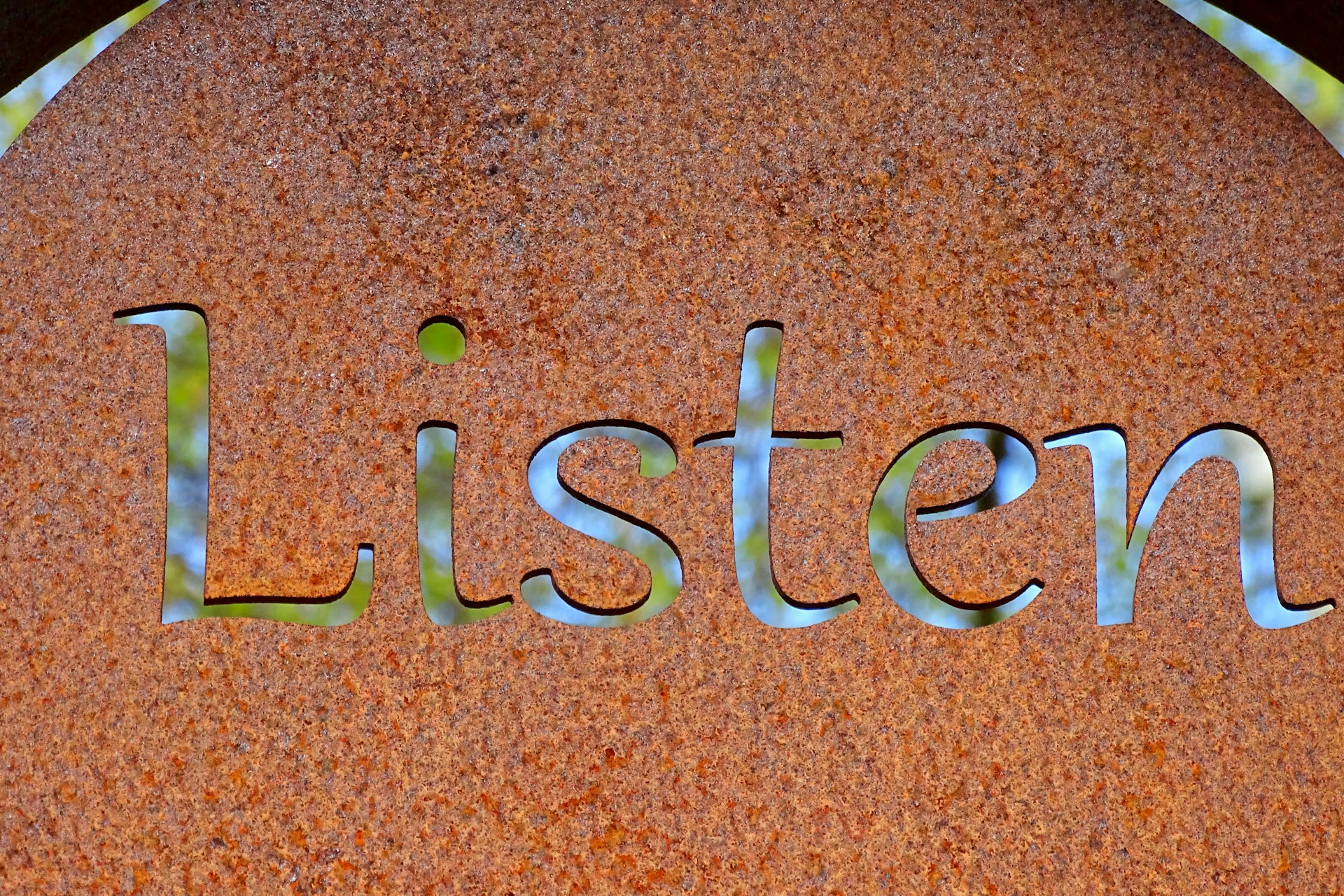
Photo by Belinda Fewings on Unsplash
Active Listening
(10 minute read)
Key Takeaways:
- Genuine listening is a moral discipline, not a passive act. Hearing words is easy; granting someone the “right to be understood” requires humility, patience, and intellectual restraint.
- Misunderstanding often stems from identity, not ignorance. People’s beliefs are deeply shaped by inherited worldviews, cultural narratives, and lived experience — not merely by a lack of information.
- The fear of being wrong often prevents real dialogue. Whether in hiring, politics, or social media exchanges, we tend to listen defensively, prioritizing validation over understanding.
- Understanding does not require agreement. We can reject someone’s conclusions while still respecting their humanity and striving to comprehend how they arrived there.
In my view, the argument about the right to control communication as production, as dissemination, and as consumption seemed to be seriously one sided, focusing on the right to utter, to publish, to broadcast, to consume. There was no reciprocal concern with an obligation to listen.
–Charles Husband, Between Listening And Understanding, Continuum: Journal of Media & Cultural Studies, Vol. 23, No. 4, August 2009
The Burden of Trying to Understand
Husband, a social scientist at the University of Helsinki, is an advocate for free speech, which includes producing, sharing information and ensuring everyone has access to it; a key part of democracy. But that last part, what does the obligation to listen mean?
There is a troubling trend in the business world: the perception that leaders aren’t interested in listening to their employees and many organizations are experiencing this at an alarming rate. When it starts at the top, it affects the entire company.
This often becomes clear during the interview process for new employees. Anyone who has ever written an employment classified ad will declare, “We just want to look for and hire the most qualified candidate to fill the position.”
NYTimes Best Selling author Martin Yate has noted how this is a problem in his perennial work, Knock ’em Dead: The Ultimate Job Search Guide and contends the usual process of hiring does just the opposite.
Yate argues that interviewers are not opponents, but rather people who genuinely want to hire candidates that fit the role. However, they often find the process distasteful and prefer a quick ending to it, putting them at a disadvantage. Interviewees should note this and listen carefully when being interviewed.
The hiring practices of organizations often rely on scripted questions that require quick answers. Instead of finding qualified candidates, the emphasis is on disqualifying them with knock out questions. Only those who pass the muster are advanced.
What if a bad candidate tricks us and gets through? No worries, the next round with new people, settings, and a closer look at the organization include questions aimed at achieving the same knockout result.
The most qualified candidates could have been passed over and the interviewers wouldn’t be the wiser because of a streamlining process in favor of a quick, rigid elimination.
And what are the type of questions we ask to weed out the bad ones?
- Tell me a little about yourself.
- How did you hear about the position?
- What do you know about our company?
- What are your strengths/weaknesses?
- How did you prepare for this interview?
To be fair, we are asking tougher questions than this. However, the process is so banal that the questions hardly merit being asked. Yet, the last person standing is deemed the winner and, presumably, offered the position.
We might be loathe to admit it, but the last person standing might not be the most qualified.
If this critique of corporate communication is accurate, then the problem extends beyond hiring practices—it reveals something deeper about how we engage with information itself.
As receivers of information, we have a duty to understand those who are communicating. Effective communication requires two-way efforts fostering understand, which seems to be lacking in our society. Talking less and actively listening more? That takes patience and practice.
Listening vs. Hearing
Creating and sending messages to the public comes with great responsibility. This responsibility often emphasizes the need for truthfulness, which means being factual with clear messages.
An audience losing trust in a speaker is a fate worse than death. Lose it and it may mean any attempt at communicating can be over. So can a career. There are plenty of examples of those who have lost just that through a Tweet or viral video, free speech notwithstanding.
In the days of AI and daily campaigns of misinformation it’s more important than ever that we diligently test whether those messages as truthful, factual, and correct. Listening and understanding is vital.
Listening, it seems to me, is an act of attention, a willingness to focus on the other, to heed both their presence and their communication… Understanding, on the other hand, is an act of empathetic comprehension, a willing searching after the other’s intention and message. –Husband
Husband’s admonishment is that all of us have an obligation to actively listen to one another because all of us have the right to be understood, especially those who have a different worldview.
It’s easy to accept messages that align with our views. Confirmation Bias is the tendency to focus on information that supports our beliefs while ignoring what challenges them. This results in only paying attention to sources that we agree with, leading to the silo effect. Consequently, we develop an unhealthy information diet, become suspicious of others, and create an us vs. them mentality.
If we can stop dismissing communicators because of our biases, we may enter a healthier space of tolerance. To achieve this, we’ll need to actively listen to others. For some of us that will be a painful endeavor. But setting aside our biases is important. It lets us consider the information, which is key to critical thinking and understanding.
The right to be understood requires that we diligently be open to that interaction. That we decide to try and understand different perspectives. We can vehemently disagree with their conclusion, but they have a right to be understood. Why and how they’ve reached their conclusions is sometimes just as important as the conclusions themselves.
Without that commitment, we are left with parties talking at or beyond each other. In fact, social media platforms have devolved into these forms of broken communication where statements full of vitriol, Pavlovian in nature, and bland in content are a blood sport.
How Did It All Begin?
There is one true thing about everyone and it applies no matter what race, creed, or color. We who were born into the human race arrived here without any formal invitation. Some believe that there is no grand design or plan for our existence. Others disagree.
There are various myths created throughout time to explain our existence; how or why we are here, to provide context, purpose and meaning. We may believe that ours is the only correct one, but that only adds to our bias.
That there are and have been so many beliefs is telling. We don’t have one universal existential answer for the satisfaction of all. Scientist’s are pretty sure how we got here, why still remains a mystery (if there is such a thing).
Nevertheless, that leads us to the central point.
Like Dorothy in The Wizard of Oz, who needs to follow the Yellow Brick Road to get home, we have to start at the beginning. Our first step may not be as dramatic, but it determines where we’ll end up.
All of Us Are Trying to Figure Out…
If we are to accept that all of us are trying to figure it out as we go along it certainly helps us to begin understanding one another. When considered, it completely explains many aspects of human behavior and why we believe the things we do.
Most of us inherit our belief system and worldview from our environment; family, community, friends, religious organizations, and so on. We need them to provide some sense of context and balance. Equally important is that most of us don’t question those beliefs or worldviews.
So, if all of us are trying to figure it out, what is the it we’re trying to figure out?
…Our Place in the World
In other words, where do I, you, we …fit in?
If we are committed to understanding one another, it’s important to start by realizing that we all basically have the same psychological and emotional needs. No matter how different and diverse our worldviews are, in the end, we are all just trying to find our place in it. If we start from here it may provide a commonality that is sorely missing from our society.
When engaging others on your favorite social media platform, keep that in mind first and foremost. The comments posted there will usually have a broader and more important message hidden in plain sight.
A Texan asked his neighbor to stop shooting his AR-15 at 11 pm as his infant was trying to sleep. This neighbor then shot to death 5 in this Texan’s family including an 8-yr-old. Ted Cruz has said NOTHING. Greg Abbott has said NOTHING. Domestic terrorism is now a plank of the GOP.
–Lindy Li on Twitter
Thanks for reminding me how important it is to purchase guns for my families safety. Do you think that guy is going to comply with laws? Do you think guns are just going to go away?
–Toni Bones on Twitter
Mm yes just have a shootout with the guy, that’s a great way to make the country safer, instead of, idk, making sure the guy couldn’t have gotten a gun in the first place.
–BlasianKing On Twiiter
This is just one random exchange. On the surface the posts might only reflect the hot political issue of the day. Yet, behind the message there are deep concerns being expressed. Ultimately, what is really being asserted is, “What kind of a world do I (we) want to live in?”
It might be hard for some of us to defend any of the statements above. Very few of us think alike. But acknowledging another’s viewpoint is not the same as endorsement.
I am a professional communicator and teacher in that order. I would coach each of the participants differently. But that’s what communicators do. Like English teachers it is hard for us to not think about helping others communicate more clearly.
It may seem odd to you to read that statement. You might wonder if I lack a political backbone and I understand that criticism.
Why in the world would you help someone with opposing political viewpoints get their ideas across more clearly?
The answer for me is simple. I had lots of practice teaching in higher education and had to do it all the time. I also happen to think that we are all in this together; that we are all trying to figure out the world and our role in it. Listening disciplines the heart and mind long before it disciplines any political stance.
With my sincerest apologies to biographer Evelyn Hall as I take creative license with her work when she paraphrased Voltaire.
I may not agree with your worldview, but I will defend to the death your right in trying to find one.
At the same time, I hope that you’ll give me the same courtesy. It’s a small way to exercise empathy, but it goes a long way in understanding.
With very few exceptions, each of us have the rights and privilege of free speech. Just as important, each of us have a right to be understood and that only happens if we agree to actually listen.
Since you’ve taken the time to read this essay, thanks for giving me the opportunity to be understood.
Now it’s your turn.
Editor’s note: This post was originally titled, A Call To Listen: The Right To Be Understood Pts. 1-2, and was published 4/18–5/1, 2023. It has been condensed and edited for clarity and continuity.
Leave a Reply