
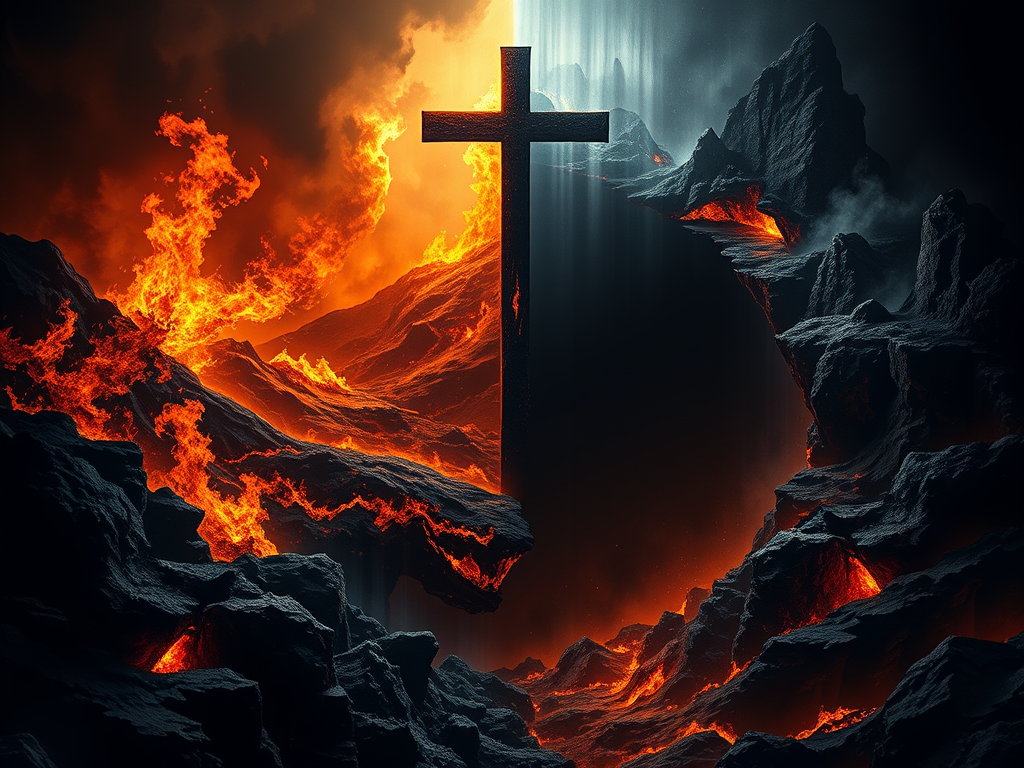
(Image by Freepik)
From Early Restraint to Doctrinal Certainty
(7 minute read)
Key Takeaways:
- The modern concept of hell as eternal torment developed gradually and is not clearly defined in the earliest Christian writings.
- Key biblical terms like Sheol, Hades, and Gehenna were later translated and interpreted in ways that shaped the myth of hell.
- Paul’s earlier letters emphasize resurrection and transformation rather than punishment in an afterlife.
- The doctrine of hell evolved through theological debate, translation choices, and institutional motives rather than explicit, consistent scriptural teaching.
In The Emerging Christian Myths 8, we examined how the earliest Christian writings—especially the Gospels and Paul’s letters—give relatively little attention to detailed teachings about hell and the afterlife. More fully developed doctrines on these subjects appear gradually in later centuries, particularly as Christianity spreads into predominantly Gentile contexts. Tracing this historical development helps us see that theological ideas do not emerge fully formed, but take shape over time within changing cultural and institutional settings.
How Fear Won: The Invention of Eternal Torment
How did a shadowy metaphor about death and destruction become a fully furnished chamber of eternal torture? The idea of hell as unending conscious torment did not descend from the sky fully formed. It emerged slowly—shaped by fear, politics, translation choices, and theological rivalry. To understand how this happened, we have to peel back centuries of assumption and return to the earliest sources, where the story looks very different from what many modern believers have been taught.
Those who take a more literal approach to scripture often refer to the Book of Revelation as support for the idea of a literal hell. So let’s begin there.
The Book of Revelation is generally dated to the late first century, several decades after the death of Jesus. It reflects a worldview shaped by apocalyptic imagery, including the idea of an ongoing cosmic struggle between good and evil. Many scholars believe it was written at a time when some Christian communities were experiencing social pressure and periods of persecution.
It offers a vivid vision of what the world might look like if evil were allowed to run its course. The imagery is powerful and deeply symbolic. Many scholars suggest that, rather than providing a literal forecast of future events, Revelation paints a broad picture of evil’s eventual defeat. In this telling, the end of evil opens the way for God to establish a new kingdom, where believers are given the hope of eternal life.
And what, then, happens to the wicked? As in many other New Testament passages, they are described simply as perishing—dead, no longer alive. The language suggests an end of life rather than ongoing torment. This reflects an earlier stage in Christian thought, before later doctrines of an afterlife hell had fully developed.
Revelation was never intended to serve as a systematic explanation of a literal hell. Yet it is often treated as if it were. Today, nearly six out of ten Americans say they believe in hell, and Revelation is frequently cited in support—despite the long and complex history that shaped those interpretations.
When we look at other Christian writings on the subject, the picture can become even more complex. Hell is often described in two primary ways: as a literal place of eternal fire and, at the same time, as a realm of profound darkness. These differing images have contributed to ongoing questions about how the concept should be understood.
When scripture describes hell as both outer darkness and consuming fire, the tension itself signals metaphor. Apocalyptic literature trades in vivid, even conflicting imagery to convey theological meaning. These descriptions are not architectural blueprints of the afterlife; they are symbolic expressions of judgment, loss, and separation. Taking them as literal geography risks missing the point of the genre entirely.
For those who read these passages literally, the specific details often become secondary. The response I most frequently hear is, “With God all things are possible.” For many, this phrase serves as a way of affirming divine mystery rather than engaging the internal tensions of the imagery itself.
Over the centuries, theologians have often tried to clarify and expand upon these passages, attempting to fill in what they perceived as gaps. In the process, certain translations and interpretations shaped how later generations understood the text. As support for the doctrine of hell, readers frequently point to terms such as Sheol, Hades, and Gehinnom (Gehenna), though each of these words carries its own historical and cultural context.
In the Hebrew Bible, *Sheol* generally refers to the realm of the dead — a shadowy place associated with silence and the grave rather than active torment. The Greek term *Hades* carries a similar meaning in many contexts. *Gehenna*, by contrast, refers to a real valley south of Jerusalem, historically associated with judgment imagery. Some biblical traditions link it to earlier practices of child sacrifice, and later Jewish writings portray it as a place of divine judgment. Over time, these distinct terms were increasingly read together and folded into a single concept of “hell.”
The Hebrew term *Gehinnom* appears in Greek as *Gehenna* in passages such as Matthew 18:9: “And if your eye causes you to stumble, tear it out and throw it away; it is better for you to enter life with one eye than to have two eyes and be thrown into the Gehenna of fire.”
In its original context, Gehenna referred to the Valley of Hinnom outside Jerusalem, a real geographic location that had become associated with judgment imagery. The language evokes that familiar setting rather than the later, fully developed concept of hell found in subsequent Christian tradition.
In Matthew’s Gospel, Jesus speaks of two “gates” through which one may pass. One is narrow and demanding, yet it leads to life. The other is wide and easy, but it leads to destruction. The contrast is stark, yet the language emphasizes life and loss rather than a detailed description of eternal torment.
Some readers point to another passage as support for the doctrine of hell: the parable of the rich man and Lazarus in Luke’s Gospel. This text, generally dated to several decades after the death of Jesus, reflects the theological concerns and literary conventions of its time. As with other passages, its imagery invites careful consideration of genre and context.
The story describes two men who arrive at very different outcomes. It is presented as a parable — a narrative form used to communicate moral and theological insight. Within its immediate context, the emphasis falls on themes of justice, compassion, and the reversal of fortunes between the wealthy and the poor. Rather than offering a systematic account of the afterlife, the story appears designed to underscore ethical responsibility in the present.
Another example appears in Matthew’s Gospel, generally dated to roughly the same period as Luke. In several passages (Matt. 5:22; 8:12; 18:8–9; 22:13; 25:41), Jesus uses imagery such as Gehenna, outer darkness, and eternal fire. In later English translations, these varied expressions were sometimes rendered simply as “hell,” a choice that has influenced how readers have understood these texts (see below).
Manufacturing Damnation: How Theology Turned Metaphor into Threat
Many of us have been taught to assume the existence of hell, often imagined in vivid and unsettling detail. That expectation can shape how we read certain passages, especially when the imagery feels dramatic or severe. Yet the earliest Christian writings — the letters of the Apostle Paul — predate the other texts of the New Testament.
In these letters Paul outlines many foundational Christian themes, yet he does not present a developed doctrine of hell. One possible explanation is that Paul’s theology is shaped by a strong expectation of Christ’s imminent return. In several passages he speaks as though the culmination of history could occur within his own lifetime. If Paul anticipated the arrival of God’s kingdom in the near future, questions about a prolonged post‑mortem state may not have occupied the same central place they later would in Christian thought.
Paul wrote to the Christians in Rome that “the wages of sin is death.” Many interpreters understand this language to emphasize mortality and loss of life rather than a detailed portrayal of eternal torment in a specific locale. In this reading, the contrast is between perishing and sharing in the life of God’s kingdom, not between two everlasting states of conscious existence.
In his later letters, Paul appears to acknowledge the possibility that he himself might die before the anticipated return of Christ. This shift seems to prompt a more reflective consideration of what lies beyond death. Even so, his comments remain brief and do not develop into a detailed account of the afterlife.
Complicating matters further, when the Greek Scriptures were translated into Latin in the late fourth and early fifth centuries, certain terms were rendered with the Latin word often translated into English as “hell.” These translation choices played a significant role in shaping how later readers understood the relevant passages.
The 1611 English translation carried forward many of these earlier Latin renderings. As a result, certain interpretive choices became further embedded in the English-speaking tradition, influencing how readers understood key passages.
These translation and interpretive developments contributed to what later became a more fully formed doctrine of hell, often understood as a literal place of eternal punishment for the wicked. Without those particular linguistic and theological shifts, the concept may have taken a different shape in Christian thought. It is also possible that contemporary survey results, such as the Gallup figures noted earlier, would reflect a different set of assumptions about the afterlife.
The modern doctrine of hell developed over many centuries. At various points in church history, certain theological positions were affirmed through formal authority structures, sometimes in contexts marked by significant institutional pressure. In some cases, dissent could carry serious consequences, including excommunication. Church leaders often maintained that their conclusions were guided by the Spirit, reflecting their understanding of divine authority in shaping doctrine.
Taken together, these textual, theological, and historical developments suggest that the modern understanding of hell did not emerge fully formed from the earliest Christian writings. Rather, it appears to have evolved gradually through layers of interpretation, translation, and doctrinal debate.
By returning to the earliest sources and reading them within their historical context, we may gain a clearer understanding of what the first Christians actually proclaimed — and what later generations came to assume.
There are those who will argue that recognizing this history does not necessarily require dismissing the tradition outright. It does, however, invite a more thoughtful reexamination of how beliefs take shape and allow for assumptions to be more thoughtfully examined.
Read The Emerging Christian Myths 10
Sources
- R. Allen Killen, Hell, Wycliffe Bible Encyclopedia, Moody Press, 1982
- Elaine Pagels, The Origin of Satan, Vintage Books, 1995
- Charles Panati, Sacred Origins of Profound Things, Penguin/Arkana Books, 1996
- Russel Shorto, Gospel Truth, Riverhead Books, 1998
Leave a Reply