
(7 minute read)
(From the previous post): The Christian sect began to separate from its Jewish roots. As they began to recognize the differences from their Jewish brothers they formed a new identity. Creating a more colorful definition of the afterlife did not happen overnight.
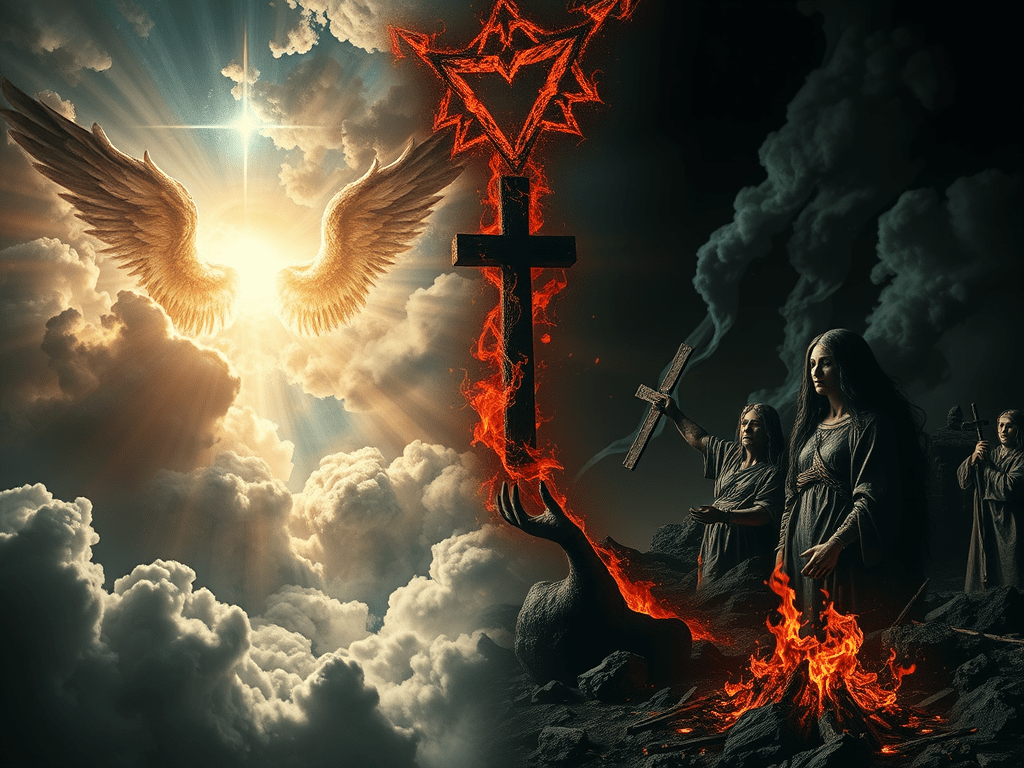
Over the centuries …yes centuries! …the Christians created and elevated the elements of an afterlife that compared with no one. Especially their construct of hell, which would eventually produce some of the most torturous, sadistic imagery imaginable.
Ironically, at various times throughout history, the Christian church unleashed hell on earth. They did this through their various inquisitions, persecution of heretics, and forced conversions to the faith.
The Gospels
Our human nature drives us to confirm intangible things with the tangible. Let’s look at some of the early writings of the Christian faith, starting with the Gospels. This is where Christians have wrongly pointed to justify their beliefs in an unseen world.
The Gospel, or Good News, according to Mark is one of the earliest writings of the early church. “Mark” was written 35-40 years after the death of Jesus. This is about one generation later. The effort is not to give a historical account of Jesus. Instead, it is a theological treatise.
The gospel is written before the Christian church is fully organized. Many events found in the other gospels are suspiciously missing from Mark. These include the virgin birth of Jesus. There is also the absence of a resurrected Jesus (though a tacked version appears on later manuscripts).
These two omissions are the bedrock of Christian dogma. It is remarkable that they are not found in the earliest of Christian writings.
As noted earlier the early church used the First Testament to confirm their beliefs. They did this by wrongfully tracing and twisting scripture. Many of the Christian doctrines point to these scriptures. Yet, a literal or metaphorical hell is not one of those doctrines.
The problem is, especially for Mark, Jesus never said anything about hell. You may be shocked to learn that hell is never really properly addressed anywhere in the Second Testament. This also applies to the gospels of Luke and Matthew. These gospels were written one generation after Mark, two generations after the death of Jesus.
They, too, offer only traces of information about an afterlife (see below).
Given the modern belief in a literal hell one has to wonder how in the hell …did hell …become such a prevalent part of the Christian faith?
Beginning at the Beginning
First, at the time the Christian sect of Judaism is breaking away, the Jewish faith lacks a wholesale afterlife doctrine. It does not even have a doctrine on hell. At the time, it seems that the Essene community is the only Jewish group to have developed an elaborate doctrine. They focused on the spirit world and afterlife.
More about the Essene community below.
Second, the Christian authors follow their convictions with this “new religion.” Authors like “Mark” tackle the immediate issues facing the community. We can infer that the first century church IS NOT concerned at all about hell. The lack of addressing the topic indicates they are not concerned about Satan or demons either.
The omission of any mention of hell leaves scholars wondering. Given what little detail there is they question if the historical Jesus believed in that realm at all.
Taken at face value the Jesus found in Mark’s gospel is far more mysterious than in the other gospels. He seems to be a loner, with a penchant for brevity in his words and has an aversion to attention. He stops a demon from revealing his identity. He admonishes people that are healed “not to tell anyone.” He is mysterious, constantly misunderstood, and seems to have one aim only.
To die.
Despite all the preparations he makes with his disciples they are incapable of fully grasping that reality. The passion narration seems to support this. In facing death he does so alone, his followers and his God abandon him.
“My God, my God, why have you forsaken me”?
Mark’s Jesus dies alone, “waiting for the vindication of God.” No elaborate promise of an afterlife only a mysterious empty tomb with no explanation.
Understanding the distinction with the early writings is important. The writings of the Christian Fathers range from the late first century to the eighth CE. In these texts, the issue of the afterlife arises significantly. Particularly, the issue of hell and its ruler becoming more prominent.
In the initial years of gathering as a group, Christians show no concern about the afterlife. That the Jewish sect called Essene might have influenced first century Christians is a very strong possibility.
The writer of Mark’s gospel may have certainly been influenced by them. That gospel opens and closes with the appearance of angels. He also introduces the devil into the opening scene and provides ample details of Jesus’ struggles against Satan’s kingdom.
Angels and the cosmic war motif are Essene constructs. The emerging invisible demon world for the Christians is beginning to form. But the dogma of heaven and hell has a long way to go with centuries to add them. This is in the Christian faith as it is known today.
What about the rest of the Second Testament?
Paul’s early epistles predate the gospels by nearly a decade. Yet, they offer little information about the afterlife. Even less about hell.
Why is there so little attention about the topic in the early church?
Answer: because the creation of elaborate myths of the afterlife starts to take form three to four generations later. This happens when the Christian membership becomes more Gentile.
Despite the lack of early evidence, the Christian doctrine of hell and the afterlife eventually becomes very prominent. Church leaders eventually demand converts reject any of the “pagan beliefs in the afterlife.” This rejection is a prerequisite to becoming a member of the Christian faith.
Pagan, meaning anything outside of Christian doctrine.
It becomes very important. Even to this day, rejecting other invisible worlds is the first step in conversion to the faith. Christian baptism requires a person to “renounce the devil and all his works.”
You don’t get in without the renounce.
You Might be Surprised What is Lacking
Over time, the Church begins to tackle the existence of hell. Yet, the information is not as thorough as you expect. In fact, compared to what a modern Christian believes about hell, the early Christians were pikers. The topic is nearly non-existent even in the later testament writings.
Below I will take on the problem with the translation of the word hell. Initially, in the first century Christian church, the topic of “hell,” like its Jewish roots, signified only the grave. But not eternal damnation.
The early Christian writers seem to take the doctrine of hell for granted as if:
- despite no written evidence the intended audience is already familiar with the topic, no need to go into detail
- the topic hadn’t been fully developed yet, details TBD over the centuries.
The second explanation is more plausible.
In any event, a lot of detail and evidence on hell is simply not there in the Second Testament.
Read The Emerging Christian Myths, Pt. 9
Sources
- R. Allen Killen, Hell, Wycliffe Bible Encyclopedia, Moody Press, 1982
- Elaine Pagels, The Origin of Satan, Vintage Books, 1995
- Charles Panati, Sacred Origins of Profound Things, Penguin/Arkana Books, 1996
- Russel Shorto, Gospel Truth, Riverhead Books, 1998
Discover more from It's Worth It!
Subscribe to get the latest posts sent to your email.

Pingback: The Emerging Christian Myths, Pt. 7 | For What It's Worth