
Taking Ownership
(10 minute read)

When it comes to education many teachers and students focus on the distribution and gathering of information.
Student: “Just give me the details that I need so I can pass the test, pass the class, get my degree, get a job, buy a house, and have 2.5 kids.”
Teacher: “My job ends when I give them the details they need so they can pass the test, pass the class, get a degree, get a job, buy a house, and have 2.5 kids.”
But the process of teaching and learning is so much more. Internalizing information is just as important.
Why?
There’s an old saying “Those who don’t know history are destined to repeat it.” George Santayana, a Harvard professor at the turn of the 20th century is the original author of that saying. To say George was an interesting character would be an understatement.
The quote stems from something Santayana wrote in his work “The Life of Reason.” The actual quote is, “Those who cannot remember the past are condemned to repeat it.” It spawned a number of iterations. The first quote above is just one.
The phrase has been thrown around so much that it has lost its meaning. It is not a plea to take history classes more seriously (though that wouldn’t hurt). Memorizing dates and facts about history is not enough. What matters is to learn from the past. Why? So that we can decide to do the right “thing” today, whatever that “thing” is. And we need more than facts to learn that.
Internalizing the lessons learned from history and what it has to teach us IS the point. This is called transformative education. Internalizing the lessons learned? It simply means the ability to take in information and answer the questions; what does that mean for us/me today?
Everything we are taught means nothing if we are can’t build and improve on what we’ve learned. We have to know what 1 + 1 equals before learning what x + 6 = 9 means.
Learning also means very little if we are unwilling to avoid the mistakes of the past. For example, the word propaganda for my generation recalls grainy film footage. Soldiers goose-stepping in the streets of Nazi Germany and elsewhere. Why? Because we were one or two generations away from one of most horrible events in human history. We studied it to learn how NOT to repeat that while recognizing those would-be dictators attempting to try it again.
Seeing Transformative Education In Action
We can usually see transformative education at work in two unique ways.
One, we see it in the educators that make an impact on us. They model and stress the need to learn and build on our education and experiences. Unfortunately educators like this are very rare.
Two, the need to recognize transformation. If learning can change us, make us better people overall, then others have that same potential.
On day one of every class I ever taught I stressed this point by letting students know my intention. As an educator I wanted to “ruin them” by instilling in them what was instilled in me. Learning facts and being passive in their education was not enough. Internalizing knowledge would allow them to be active participants in seeing how education transforms them. Not just now, but for the rest of their lives.
They just couldn’t get by in life sleep-walking. They had to be awake and active participants in their education.
Transformation comes first by providing the fundamental and critical knowledge needed in whatever discipline is being taught. Harvard professor and cognitive psychologist, Stephen Pinker, likens communication to brain surgery; transplanting our ideas into the brain of another.
Transformation also comes through exploring and recognizing our internal changes as we continue to learn. This isn’t some new age gobbledegook. Education is potentially transformative.
Transformative education can only take place when the teacher and student are active participants. As we become aware of our own transformation it allows us to be open and accepting of others. If we can change, so can others. It helps us to become better citizens.
Over the years I have been given some well intended but very poor advice. It boiled down to this, being a good educator means “elevating and separating ourselves from our students. You have to let them know who’s boss on day one.”
I find the opposite to be true. I don’t try and be a buddy to my students, only accessible and transparent. A student first judges a teacher by the knowledge offered in the class. When that same educator is approachable the effect on a student’s life can indeed be life changing.
As educators we are given an awesome responsibility.
Learning Is The Thing
“There is only one thing (in life) …to learn. Learn why the world wags and what wags it. That is the only thing that the mind can never exhaust, never alienate, never be tortured by, never fear or distrust, and never dream of regretting. Learning is the thing for you.”
— T.H. White, The Once and Future King
This is Merlin advising the young King Arthur in White’s The Once and Future King. I’ll also add Parker Palmer’s assessment. Education is at its best when knowing, teaching, and learning is not just about gaining information. Nor is it just about starting careers and having nice things.
Education is about liberation, empowerment, and transcendence (don’t think I kept that “little” secret from my students).
Like many of life’s crises, there are some things we are unable to control. We will have to recognize those things that are and those that are not. Those things that we have some influence with are the ones we can concentrate on.
Knowing what we can and cannot control should be our first order of business.
I am keenly aware that there is a minority of educators who voted for, welcomed, even rooting for this crises. They are playing a game that gives them temporary satisfaction. They have yet to be affected the way others have been.
How do I know this? Because I used to be one of them.
For the rest of us, the majority that still desires a democracy, what can we do under the current crises?
Short term goal is to control our reaction to the chaos. Long term goal is to mantle up while dis-mantling down.
To mantle up we need to wear the cloak and embrace the calling of a teacher. One that is willing to stand up for what’s right. When an organization makes decisions contrary to what we know is right there are three things that we can do.
- Give up and accept the change
- Stay and fight until it’s right
- Get out
By dismantling down we need to deconstruct the ivory towers of higher education, brick by brick. Only then can we re-purpose them for building bridges into the community.
Schools of higher education are in a unique position. We can offer citizens a way to liberate economic and cultural differences. We can also challenge our students to go into the world and be “agents of change.”
It is in the halls of academia where real learning and experience empowers students. They should be readied to enter the world with more than just knowledge. Education doesn’t stop with accomplished degrees. A lifetime of learning and forever empowerment always awaits them.
Educators can also confirm the talents of students, encouraging them to pursue and transcend into their vocations. For many students this may be the first time an adult has ever encouraged them this way.
Because of this, educators too, must understand that their mission also includes their own personal transcendence. That means we must first be on the road of liberation, empowerment, involvement, and availability.
In other words, we should lead by example. As Palmer writes, to be active participants in forming our “identity, integrity, character, and inner life.” To take ownership in becoming the solution to the crises. To refuse to accept it as a personal crises.
The Big Question
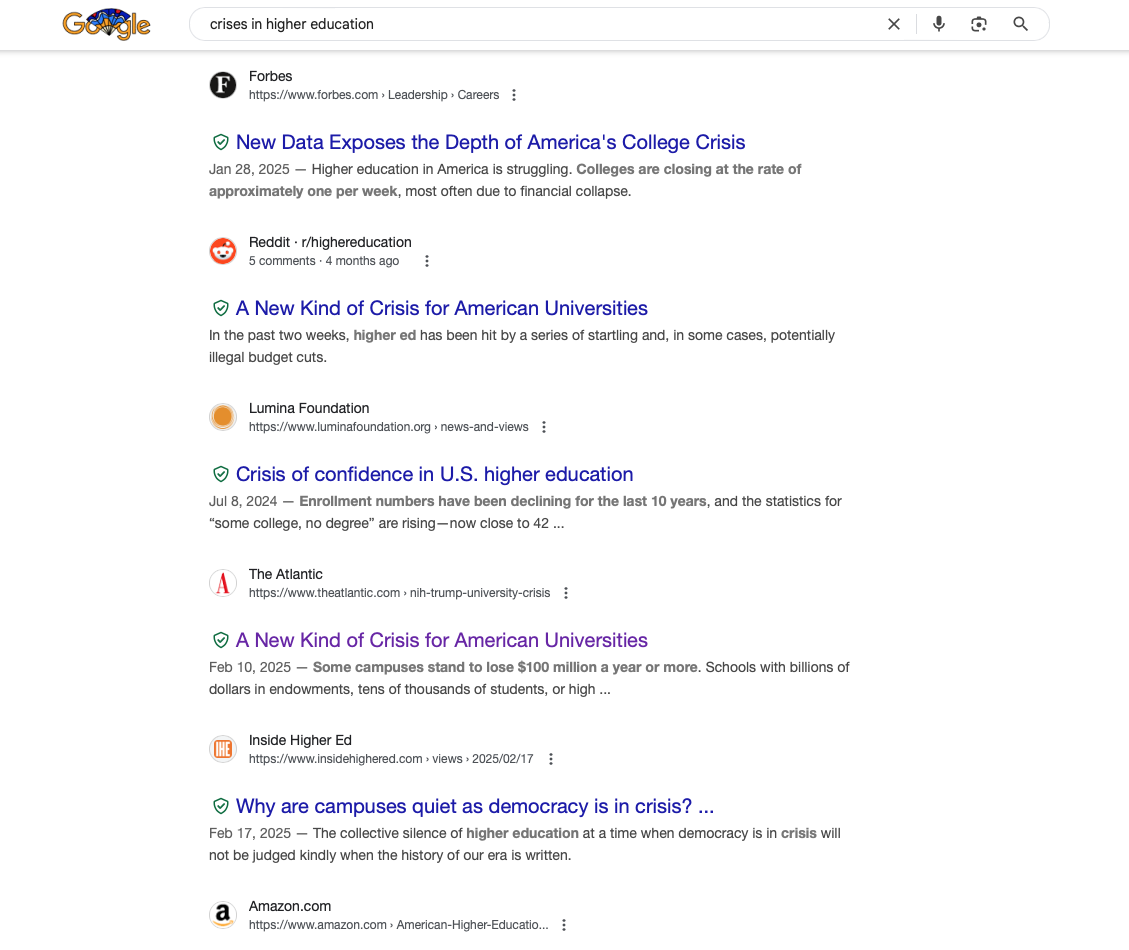
A web search on the crises in higher education will net you with an abundance of current difficulties. But I ask, Is it possible that some of the crisis stems from our own sense of personal crisis?
I posed this question in a paper and presentation submitted at a conference in 2007. At that time there were many looming crises.
Budget deficits, low student enrollment, a decline in the pool of eligible students, an aging professorship, a surplus of Ph.D. graduates, Web 2.0, the proliferation of social media platforms, the irritations of dealing with student’s growing sense of self-entitlement, etc.
All these seems quaint given the current political climate.
In ’07 I went on to further ask if we were the victims of our own paranoia? This was, and still is, a really loaded question. It is obvious what I think. If not it will be soon enough.
By 2007 I saw too many crises. Some were even manufactured (shock!).
- Gas shortages
- Inflation
- Energy crises
- Impending race wars
- Watergate
- Asian countries buying and taking over America
- Recessions
- Savings and loans scandals
- Computer takeovers
- Civil rights backlash
- Looming second civil war
- Junk bonds
- Contracting AIDS from toilet seats
- Global recessions
- Y2K bug
- Death of Web 1.0
- Sub-prime mortgage scandals
- Social media frenzy
- yada yada yada
Color me skeptical whenever confronted with new societal crises.
When we are young it is natural to trust authority figures. But after many of their predictions or expert opinions fall flat we start to question that trust.
Author and national security affairs expert Tom Nichols has a lot to say about that. As a result of too many disappointments, we start to distrust all of them. A more mature approach is to be selective in our sources, scrutinizing them before they earn our trust.
Owning It
Is this a crises of our own making? To answer that we’ll need to define what it is that we do as educators. How we give meaning to what we do and what our role is in society is important.
What is the fundamental way in which we do our work? And how do we get there from here? It’s important how we answer. Like Dorthy in the Wizard of Oz, the way to the Emerald City is to start on a particular road. Veer off course and she might not get there. That first step to getting there is vital.
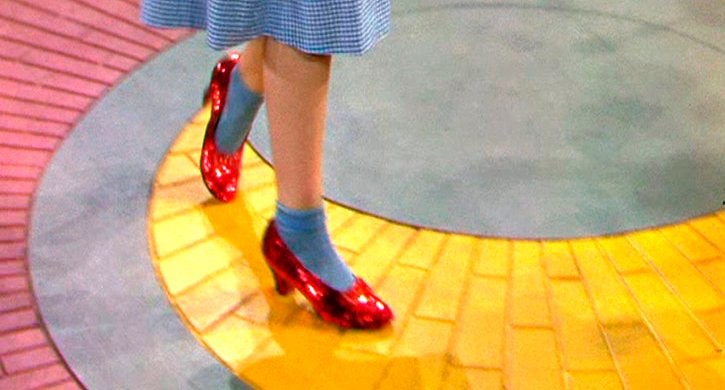
Like Dorothy, our first step is too. Being grounded as educators comes by establishing our identity and integrity, the first brick. We do this by defining our roles as educators.
Conventional wisdom says the internal workings of an individual are private. As an introvert I like to agree.
Yet, scholars like Stephen Webb, Parker Palmer, and Robert Greenleaf (three very different academics) advocated for being more openly transparent. Education, the passing on of knowledge, has a way of internally changing a student. It also has a way of changing the educator.
Modern studies of religion is an attempt to figure out just how far reason can go in explaining our world. Where reason stops, faith fills in the blanks. How convenient. Run short of any reason and “With God, all things are possible”, is the bullshit, cop-out, cheap, lame-ass, answer.
I trust I am making myself clear. I am NOT going to take you through that eye of the needle.
Theologian Stephen Webb spent much of his life trying to unite faith and reason. An exercise in futility in my opinion (and a topic for another day). He believed that teaching was a way to model how reason and faith might come together. The students observations of the teachers habits, behaviors, and endeavors is what mattered most. “We don’t need to convert students to religion. We only need to model it.”
In a sense, I think Webb was onto something, though not to his full conclusion.
Hang in with me here.
No matter what flavor of one’s religion one cannot help but to model that religion. How one “does daily life” is observable. Motivated by the teachings of the Dahlia Lama? Then you will live your life accordingly, behaving as Lama suggests.
Contrarily, if an educator is an atheist then those habits, behaviors, and endeavors will also be observed. Likewise, if one is motivated by material wealth, social status, sports, etc., learners will also take notice of those same habits, behaviors, and endeavors.
Over time, the students will get a hint at what a teacher’s internal life is.
In this way what is transferred to learners is not what is “taught” but what is “caught.” What is caught by students is the attitude and philosophy of teachers, their way of life, if you will.
Our behaviors and habits make a difference in the life of the learner more than we think.
Read University in Crises, (Pt.5)
Discover more from It's Worth It!
Subscribe to get the latest posts sent to your email.

Pingback: The University In Crisis: A Personal Crisis? (Pt. 12) | For What It's Worth