
(10 minute read)

Image by benzoix on Freepik
- Maxim #1: See the world as it is and not as you would like it to be
- Maxim #2: See the world as you would like it to be and not as it is
Philosophy, psychology, and sociology are soft sciences. They have a long history. They try to help define how humans interpret and interact with the world. In other words, how to make sense of the world in which we are living. Religion has an even longer tradition of trying to do the same.
I have studied the soft sciences for a lifetime. At the risk of being too simplistic, It appears to me that there are two schools of thought. These can be described by the two maxims shown above. The first maxim seems to encourage us to be realists and look at the world as it really is. The second seems to encourage us to reject that notion and create a world we want to live in.
Upon first glance these maxims seem to contradict one another. In fact, I think that the opposite is true, they actually compliment each other.
From Maine To Illinois
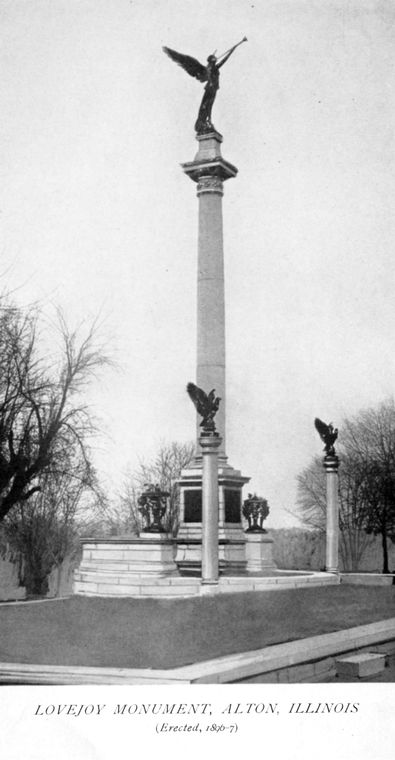
Image courtesy of the New York Public Library Digital Collections
In Alton, Illinois an eleven-story monument stands as a testament to the works and life of Elijah P. Lovejoy (pictured above). The idea that you are aware of who Lovejoy is rather remote. My guess is that many of us are more familiar with the Rev. Lovejoy character from the Simpson’s cartoon series than the real Lovejoy.
Born in 1802 in Albion, Maine, Elijah Parish Lovejoy was born the oldest of nine children. His mother, Elizabeth, and father, Daniel, a farmer and Congregational minister, dedicated their early years to their children. They focused on providing an education teaching them to read and write before sending them to public schools.
Upon finishing public studies, Lovejoy attended private academies in Main. He then formally attended Waterville College where he graduated as class valedictorian in 1826. He intended to start a career in teaching. But he quickly became tired of it. In 1827, he decided to make the trek to the western territories, settling in St. Louis.
Unable to find work, he established a private academy with a friend. However, he lost interest again when local newspapers began to buy his poems for publishing. In 1829 he became co-editor of the St. Louis Times where he worked with like minded community leaders.
Although Missouri was a slave state, the majority of people in St. Louis did not consider themselves tied to Southern slavery. Instead, they considered themselves progressives and keepers of the great “gateway to the west.”
At the same time Lovejoy’s political clarity was coming into its own. He struggled with his roots to religion, writing to his parents about his shortcomings. Desperately searching for answers he attended a revival meeting where he credited the rekindling the religion of his youth.
He sold his interest in the Times, moving back East to study theology at Princeton. He graduated in 1833 and moved to Philadelphia. There, he was became the minister at the Presbyterian Church. That same year a contingency of St. Louis citizens desired to start up a religious newspaper. They contacted Lovejoy and made him an offer to come back and be editor. He accepted, moved back to St. Louis, and published the first edition of the St. Louis Observer in the fall of that year.
At least 60% of the St. Louis population was Catholic. The founders of the Observer were concerned about having undue influence in the community. To counter, over the next few years, Lovejoy wrote many editorials critical of the Catholic Church. He eventually broadened that criticism to the institution of slavery.
In spring of 1835, a rival state newspaper, the Missouri Republican, caught Lovejoy’s attention. They were strongly advocating for the gradual emancipation of all slaves. Lovejoy, in turn, echoed the sentiment admonishing antislavery groups in Missouri to push harder for emancipation.
To his dismay, Lovejoy was shocked to find his opinion articles were so polarizing in the community. Rank political discourse became even more prominent and the community was splitting over the issue.
Up to this point, Lovejoy had only written about a gradual emancipation. Yet, this new rankle emboldened him. He soon wrote articles pushing for immediate emancipation.
“Christians,” he wrote, must “recognize that slaves were human beings who possessed a soul.”
Hard to believe that someone had to even write that to a community.
Merging his moral and religious convictions Lovejoy had now found his voice. By the fall of 1835 death threats to Lovejoy and his family were a daily occurrence. His fervency was only met with even more pushback. This reaction reinforced Lovejoy’s convictions. By the fall of 1835, death threats to him and his family were a common occurrence.
Months later, he published an editorial criticizing the burning of a black man by a lynch mob. Threats to the whole community became more prevalent. So prevalent were they that Lovejoy moved his family and operations of the Observer. They relocated 20 miles up the Mississippi River north to Alton, Illinois.
From there, Lovejoy fully embraced the abolitionist mantle. He furthered his attacks on slavery calling on all citizens of Illinois to join in the fight. Illinois was a free state. However, many business owners around Alton began to question the idea of allowing Lovejoy to continue his newspaper operations. They believed that his extreme views on slavery were bad for business. In fact, a small business crisis in 1837 led a number of businessmen to use him as a scapegoat.
On November 6, 1837, a mob of pro-slavery men gathered outside one of the Observer’s printing houses. Additionally, a number of out-of-state men joined them. Lovejoy and several of his newspapermen were inside. The mob grew restless demanding Lovejoy come out to meet with them. After several minutes, gunshots began to ring out. The mob riddled the building with bullets. Shots were returned from inside.
After several volleys, a moment of calm settled and it appeared that the conflict was over. Lovejoy opened the door. He was immediately met with a hail of gunfire. Five bullets struck his body. He died several moments later. The next day he was buried in Alton Cemetery in an unmarked grave.
Lovejoy was considered a martyr by the abolitionist movement. His death brought outrage and a renewed interest to the cause.
His brother, Owen, had seen his older brother murdered and vowed to never forsake the cause. He became the leader of the Illinois abolitionists. In 1854, he was elected to the Illinois state legislature. There, he enjoyed prominence and made political allies, including an up-and-coming lawyer, Abraham Lincoln.
Lincoln, for his part, would often speak of the sacrifice of Elisha P. Lovejoy in speeches delivered throughout his political life.
Twenty-seven years later, in 1864, St. Louis journalist Thomas Dimmick found the original unmarked grave of Lovejoy. His long forgotten grave was now under a road that had been built over it for years. His remains were removed and relocated to a spot where they would no longer be trodden upon. Dimmick arranged for a headstone.
In 1896 a memorial was commissioned at Lovejoy’s final resting place.
On it it reads:
“This monument commemorates the valor, devotion and sacrifice of the noble Defenders of the Press, who, in this city, on Nov. 7, 1837, made the first armed resistance to the aggressions of the slave power in America.”
History Is For Now
The story of Lovejoy is an important one for our times. The telling of history informs us of some of the most vital events. These events often go missing or get forgotten. They virtually slip through the cracks. History informs us of who we are and how we got here as a people.
And the thing is history is constantly “living and breathing.” Stories like Lovejoy’s become part of our understanding of the world. That’s an important point to remember. Telling history reminds us of the “story” we are living right now. Especially when we read about past events that seem to parallel our very own experiences. We often forget that we are daily living in a history that slowly unfolds right under our noses.
As I am writing I can’t help but to think about the polarization of Lovejoy’s era. It is with us today. People may not be so willing to admit that they are part of any “aggression of the slave power.” Yet, a minority group of Americans proudly identify with being a part of the “tyranny of the minority.”
- The Unite the Right rally in Charlottesville, Virginia in 2017
- The Johnstown, PA Trump supporting couple cited in a 2017 Politico article that the NFL really stood for “Ni****s For Life”
- The January 6, 2020 insurrection of the Capitol in Washington, D.C.
- The politician who wills for the death of democracy in the U.S. because of their own ambitions
By the year 2045 it is projected that White’s will no longer be the majority race. This seems to scare the bejeezus out of a minority of people. In a CNN interview, authors Steve Levitsky and Daniel Ziblatt discuss this phenomenon. Their latest book. “Tyranny of the Minority: Why American Democracy Reached the Breaking Point” is vital for the times we are living in.
“Given the numbers in this country, the only way to not empower the emerging multiracial majority in this country is through nondemocratic means. For many years in this country, prior to 1965 [when the Voting Rights Act was passed] when the demographics were different, we had what we called a democracy. But it was not providing rights and protection to all members of the community. It’s only in 1965 that we started to have this conversation about a true multiracial democracy.”
Steve Lavitsky, CNN interview, Dec. 8, 2023 [retrieved Mar. 21, 2024]
It seems that the idea of another group becoming a majority is a bridge too far. This is the reason we have a Republican Party that is willing to adopt autocracy. It is the only way they can keep control.
It Is Who And Where We Are
For over half a century, most American citizens believed they lived in a world without illusions. They saw the United States as a working democracy. Many would admit that it wasn’t perfect. Yet, many have lived long enough to know we had made progress. The year 2015 looked far better than the year 1965.
Then came 2016.
And the world we were living in?
Well, the majority of citizens had to admit that they were now living in a world that looked ugly. It leaves some to fight for a world that they want instead of the world which they see. A minority of white privileged politicians had acted. Many of them had the help of American oligarchs. A vulgar, failed real estate tycoon and television reality star also assisted. They had done something that many thought would never happen.
They created an American political power that, to this day, continues to threaten American democracy.
Discover more from It's Worth It!
Subscribe to get the latest posts sent to your email.
