
(6 minute read)
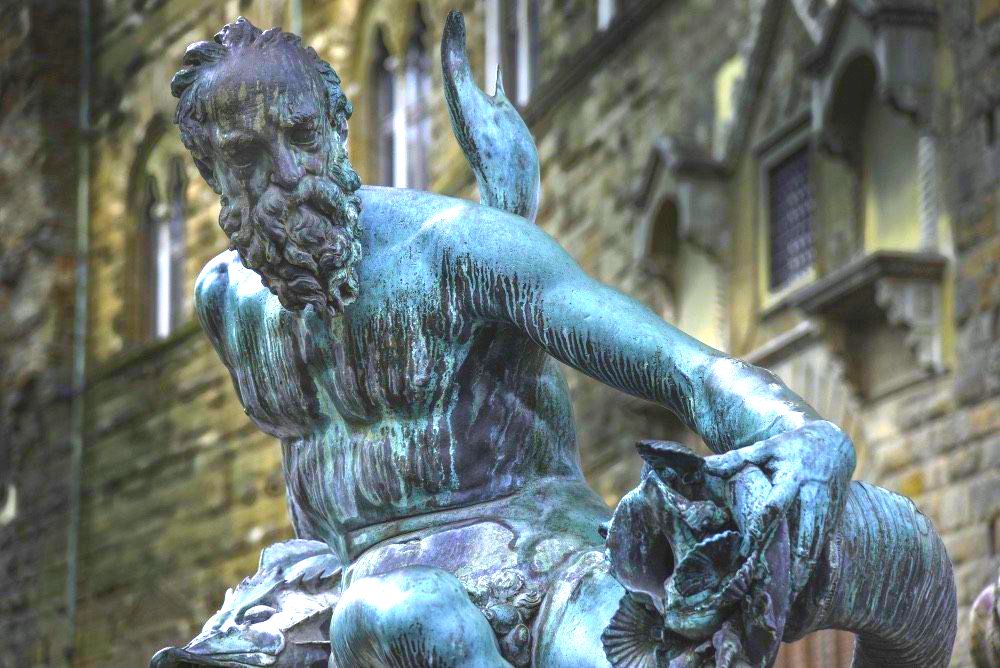
Fountain Statue of Neptune, Florence, Italy. Image by wirestock on Freepik.
“To the man on the street …the word myth brings to mind lies, fables, or widely believed falsehoods. On the nightly news, a health expert speaks of the need to eliminate commonly held myths about AIDS. In this context, myth is used to mean a misleading conception –in this case, even a dangerous misconception. But myth, in the sense that we use [here], often stands for truth …[and] is often something that only begins to work where our own five senses end.”
Parallel Myths, J.F. Bierlein, Ballantine Books, 1994
The “man on the street interview,” with few exceptions, went away with the proliferation of the internet. Today we can “Google.” A quick Google search of the word myth will usually show a list of common legends. These are things that are thought to be true but are not.
One such list is from an article posted on the BBC Science Focus Magazine website.
- A penny dropped from the top of the Eiffel Tower will kill someone
- Bumblebees defy physics
- Local honey cures hay fever
- Goldfish only have a three-second memory
- Mice love cheese
- Humans use only 10 per cent of their brains
- Etc.
28 myths of modern life exposed, Tobias Jolly, January 19, 2017, 9:00 am
Here the term “myth” describes something that is commonly believed to be true. However, in reality, it is not factual. In short, the 28 listed items fall under the category “urban myths” or “urban legends.” Despite this, they are often repeated and believed by many to be true (Cambridge Dictionary).
These are statements that are presented in a definitive way but are not true. They sound reasonably true, which is why we buy them in the first place.
It is best to live in a world where we can determine what is real and what is not. Pseudo information is often presented with supposed logic and confidence in its “rightness.” This occurs even when proven wrong. It’s becoming a worldwide epidemic. Can we at least agree on that?
When we don’t have all the facts our default position as humans is to fill in the gaps. For the sake of expediency we often do so with the wrong information.
Michael Shermer, author and editor of Skeptic magazine, highlights the problems with filling in gaps. It is a faulty practice a majority of the time. Once we recognize how faulty this practice is, we will stop jumping to conclusions. (see VII. Psychology and the Brain in the Skeptic: Introduction).
Skepticism and Not Cynicism.
The default of cynicism is to deliberately avoid having confidence in anyone or anything.
- “Politicians are all crooked”
- “Do not trust anyone over 40”
- “Professors live in ivory towers and have no sense of reality”
- “This pandemic proved that doctors really do not know what they are doing”
- “My family has disappointed me in the past and will continue to do so in the future”
- and of course the grandaddy of them all …”Experts don’t know shit!”
It is important to note that this form of “myth making” serves no purpose and the consequences can be stunning. Though often unintentional, this type of myth making also serves to promote intentional forms of misinformation by very bad actors. Tell a lie …loud, and long enough …and people will begin to believe it.
My intention is not to rescue the use of the term myth. It’s probably too late for that. As we will see later, the term still holds sway. It influences large swaths of individuals and institutions. The term now has even more purpose and a deeper meaning. My intention is to show that, despite any prejudice one may have, we still use stories and myths daily. This is true in many aspects of life. To be human is to do so.
How the Study of Myth Became My Salvation
It is safe to say that I have spent a lifetime in the pursuit of “truth.” What is true in relationships, institutions, religions, philosophies, etc.? The search for meaning was not only a philosophic pursuit. It also solidified an unapologetic affirmation of life’s existence.
The early years of my life were marked by a belief in a random existence. I thought being born into the world was an accident. I felt that I did not belong here. That was reinforced in me from an early age.
I do not know why. There was always something in the back of my mind (“like a splinter”) that refused to accept this fate. It felt that there had to be some other explanation. I wanted something that took away with the randomness and provided purpose. The options, resolve to being a mistake or finding some greater purpose, left little room for any other in-between explanation.
And so from that foggy beginning, I slowly gravitated towards stories. These were stories of people who were met with rejection, humiliation, and loneliness. In the end, they found hope. The tales of Bambi, Pinocchio, and Dumbo are well-known (Disney is roundly represented). The birth of Jesus is also a familiar tale. As I got older, I admired sports heroes like Tom Seaver and Roger Staubach.
In my teens it was Martin Luther King, Jr., John and Robert Kennedy, and my maternal and paternal grandmothers. I continued to try and make sense of the world I was living in.
It started becoming more apparent to me. It was a little at first and then accelerated. The in-between answer to the either-or question was closer to the truth. Therefore, in my estimation, it was far more interesting. In my search for meaning what I found could neatly fit into a one slide PowerPoint presentation.
I learned that it mattered very little how or why I got here. That I was here was all that mattered and while I was here I could:
- “Treat others as I wanted to be treated”
- “Honor my loved ones”
- “Strive to be truthful”
- “Do no harm to myself or others”
- “Just as my body needed nourishment, so did my inner being or soul”
The list is familiar. Each of them and more can be found as tenets or “truths” in all of the major religions. One could live a full life just adhering to these pithy little mantras alone.
I learned something else. Anthropologically speaking telling stories turns out to be a more effective form of communication and persuasion in early man. It is more effective than just memorizing a list of do’s and not do’s.
Rather than stressing memorization a communicator could impact their “audience” more by …telling stories that emphasized or modeled “truths.”
And, boy, did early man tell a lot of stories!
Read Myths and Their Impact, Pt.2
Read Myth-Making:, Pt. 2
Discover more from It's Worth It!
Subscribe to get the latest posts sent to your email.

Pingback: A Call to Listen: The Right To Be Understood (Pt. 2) | For What It's Worth